01 · The discovery
The idea, in everyday language
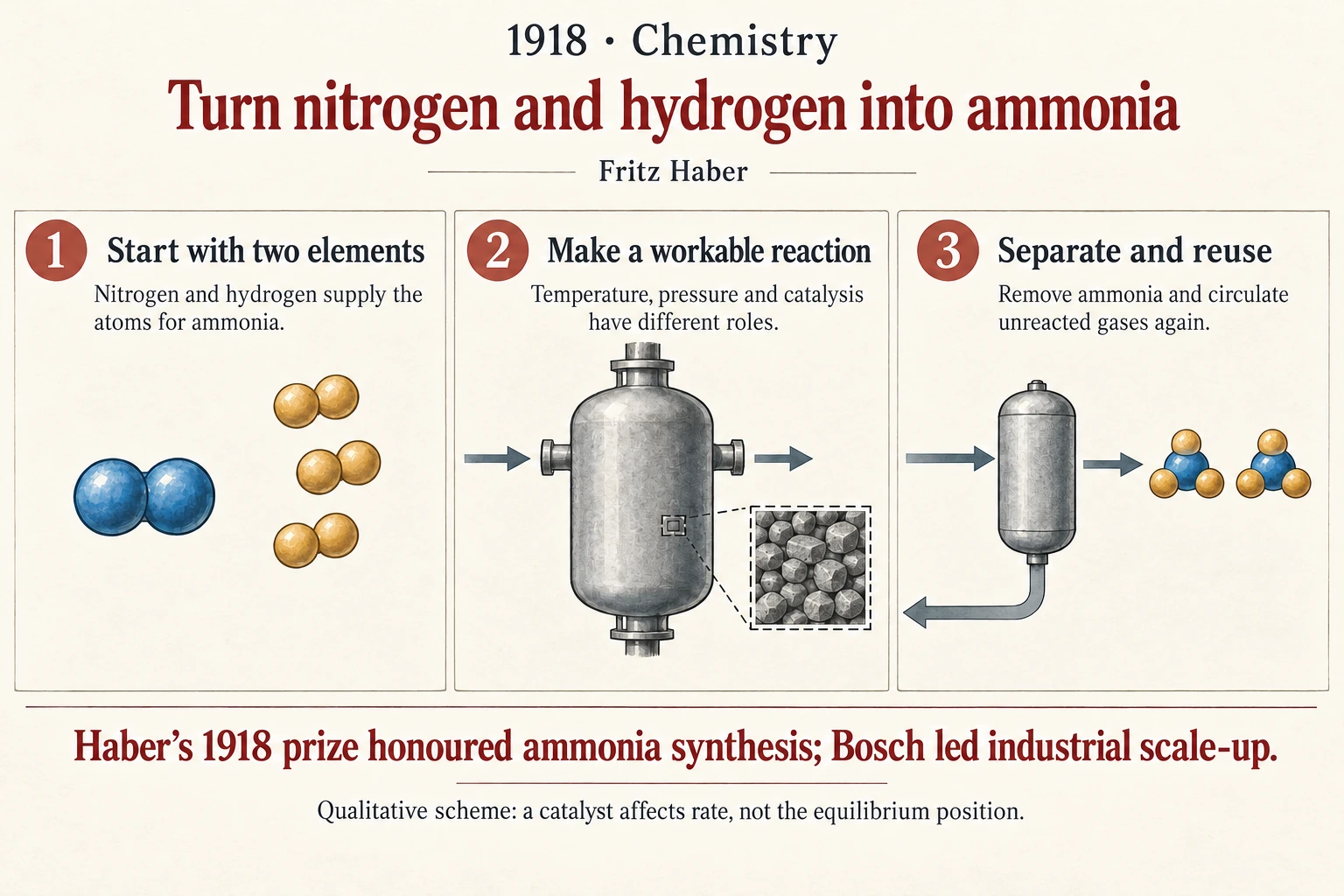
The atmosphere contains abundant nitrogen, yet most plants need nitrogen in chemically usable compounds. Making ammonia directly from nitrogen and hydrogen offered a route to an important starting material for fertilisers. The reaction presented a linked problem of equilibrium and speed: conditions favouring ammonia were not automatically conditions in which it formed fast enough for practical production.
Haber studied the physical chemistry of the reaction and, with Robert Le Rossignol, developed a working laboratory system. The Science Museum’s sample record dates a demonstration to BASF representatives to 2 July 1909. A team led by Carl Bosch had to solve further engineering and catalyst problems before BASF’s first industrial plant opened in 1913. Product separation and reuse of unreacted gases were important to the process. The reserved 1918 Chemistry Prize was announced on 13 November 1919 and presented on 1 June 1920.
Why it matters
Ammonia synthesis made a major source of chemically usable nitrogen available beyond existing natural deposits and by-products. It changed the basis of nitrogen fertiliser production and supplied material for other chemical industries. The history also includes wartime uses of nitrogen compounds, while Haber’s direct role in chemical warfare requires its own explicit account.