01 · The discovery
The idea, in everyday language
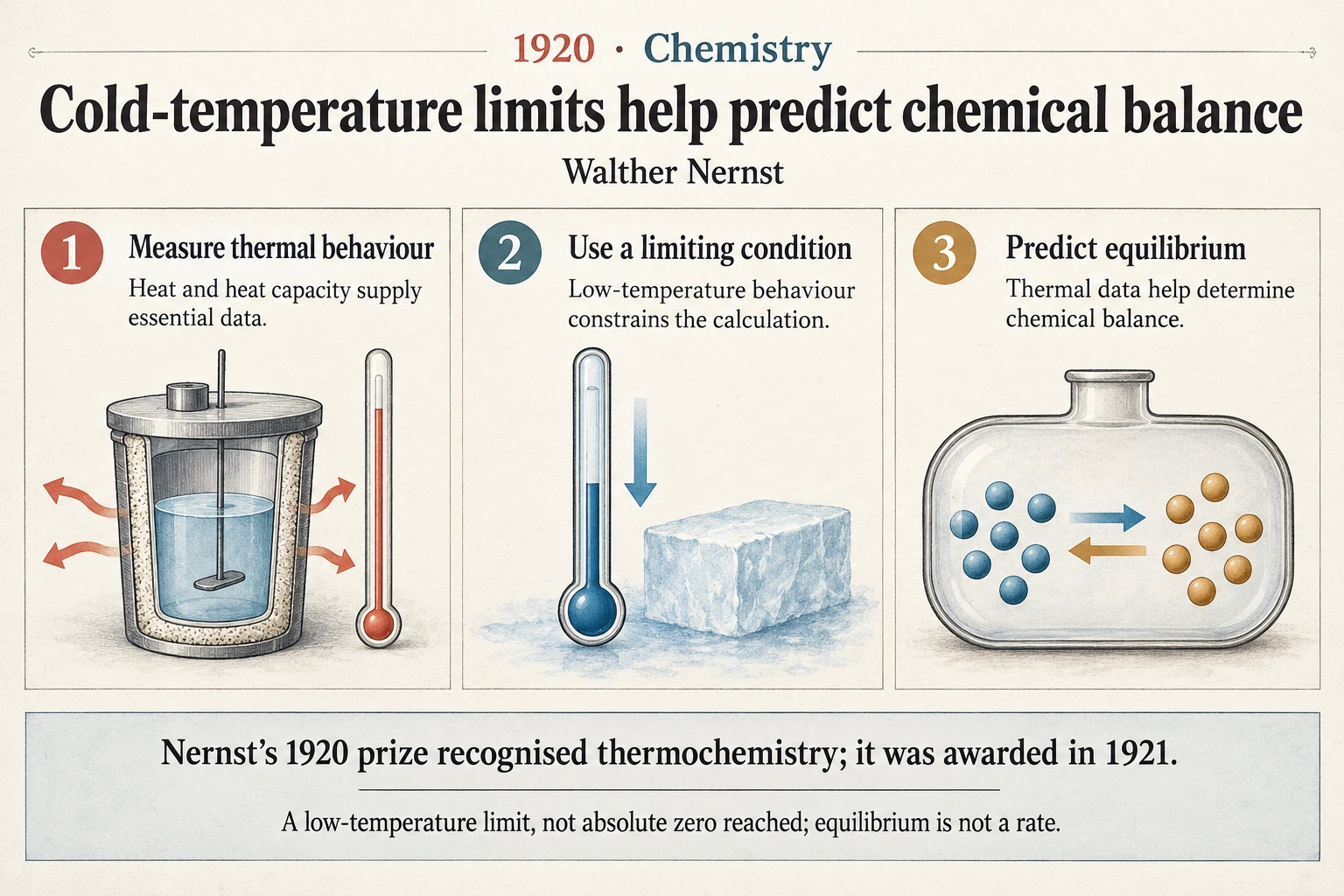
Measuring a reaction’s heat does not by itself tell us how much useful work can be obtained or what equilibrium mixture will result. Temperature matters, and heat capacities describe how substances store thermal energy as temperature changes. Thermochemistry needed a way to connect these measurements with chemical driving forces.
Nernst’s heat theorem, developed in 1906, supplied a constraint from limiting behaviour near absolute zero. Together with heat measurements and heat capacities, it helped determine free-energy changes and equilibrium conditions. His collaborators tested the reasoning through low-temperature measurements and studies of reactions and electrochemical cells. The 1920 Chemistry Prize was reserved, announced on 10 November 1921 and presented on 10 December 1921.
Why it matters
The work made equilibrium predictions more firmly connected to measurable thermal properties. It helped assess which reaction mixtures are thermodynamically favoured under stated conditions and how much useful work a change could ideally supply. Such information guides chemical understanding and process design.