A life in context
The person behind the prize
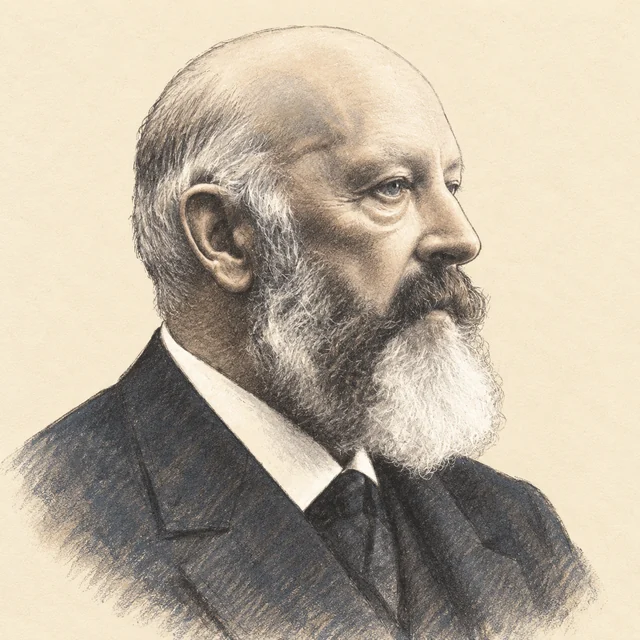
Adolf von Baeyer grew up in Berlin in a family with interests in science and literature. He initially studied mathematics and physics before joining Robert Bunsen’s laboratory at Heidelberg in 1856. Work with August Kekulé introduced him to structural ideas in organic chemistry. He received his doctorate in Berlin in 1858 and qualified to teach in 1860, when he began working at the Berlin Trade Academy. His research ranged widely, but the problem of indigo became a lasting focus from 1865. How could a useful plant dye be understood as a chemical structure and prepared from simpler starting materials? Years of study produced new compounds, synthetic routes and a clearer account of indigo’s constitution. Baeyer also discovered the phthalein dyes and explored relationships between molecular structure and colour. His students Carl Graebe and Carl Liebermann made important contributions to alizarin research; the achievements of this school should not all be assigned to its leader alone. Appointments in Strasbourg and Munich gave Baeyer opportunities to build influential teaching laboratories. Studies of carbon rings led to his strain theory, while investigations of hydroaromatic compounds connected questions about aromatic and other cyclic organic substances. The full 1905 Chemistry Prize explicitly recognised organic dyes and hydroaromatic compounds, together with their importance to chemistry and industry. Laboratory synthesis and economical factory manufacture were different achievements: BASF’s commercial indigo appeared in 1897 after prolonged further development. Baeyer was unable to attend the Stockholm ceremony because of illness, and the presentation stated that the prize would be conveyed through the German ambassador. He married Adelheid Bendemann in 1868 and died at Starnberg in 1917. His influence lay in sustained experimental inquiry, structural questions and the many researchers trained in his laboratory, rather than a single useful blue pigment.
The contribution
Baeyer received the full Chemistry Prize for advancing organic chemistry and the chemical industry through research on organic dyes and hydroaromatic compounds. Indigo research was one major part of a broader programme.
The idea in plain language
Indigo had long been obtained from plants. Understanding its chemical constitution and finding laboratory routes to it required years of experimental work. Baeyer also investigated phthalein dyes and the relationship between a substance’s structure and its colour.
Read the full award story ↗

