A life in context
The person behind the prize
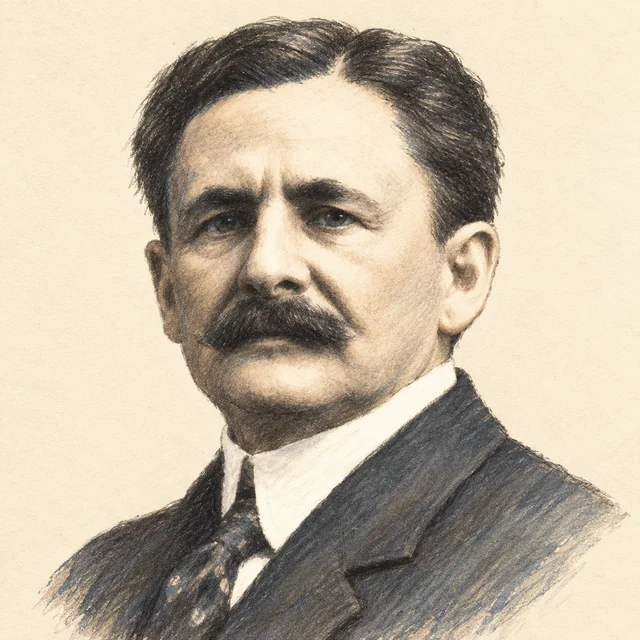
Albert Abraham Michelson emigrated to the United States with his family as a small child. He entered the United States Naval Academy in 1869 and graduated in 1873, later teaching physics and chemistry there. Measuring the speed of light became a lasting interest. Study in Europe broadened his experimental training, and appointments at the Case School of Applied Science and Clark University preceded his move to the new University of Chicago in 1892. He helped establish its physics department and laboratories. The central thread was precision: using light itself to compare distances and examine the fine structure of spectra. His interferometer divided a beam, sent the parts along different paths and recombined them so that a small change appeared as a shift in interference fringes. In 1887 he and Edward Morley used this approach in a search for the expected effect of Earth’s motion through a supposed light-carrying ether. The predicted effect was not found. That result challenged contemporary models; it was not, by itself, a proof of every proposition of special relativity. In 1892–1893 Michelson and Jean-René Benoît compared the metre with cadmium light at the International Bureau of Weights and Measures. His full 1907 Physics Prize recognised optical precision instruments and their spectroscopic and metrological uses. The Academy’s prepared presentation was not delivered at the cancelled public ceremony following King Oscar II’s death; a separate private address was given. Michelson continued research beyond the prize. With Francis Pease he measured the angular diameter of Betelgeuse in 1920 using a telescope interferometer. He died in Pasadena in 1931. His career joined instrument design, patient comparison and the recognition that a carefully established absence of an expected effect can also change physics.
The contribution
Michelson received the full Physics Prize for optical precision instruments and the spectroscopic and metrological investigations made with them. Interference turned small differences in light paths into observable fringes.
The idea in plain language
An interferometer divides a light beam into two coherent parts, sends them along different paths and brings them together again. Their relative phase determines where the combined light is bright or dark. Changing a path moves the fringes, turning a small difference into a pattern that can be observed and compared.
Read the full award story ↗

