A life in context
The person behind the prize
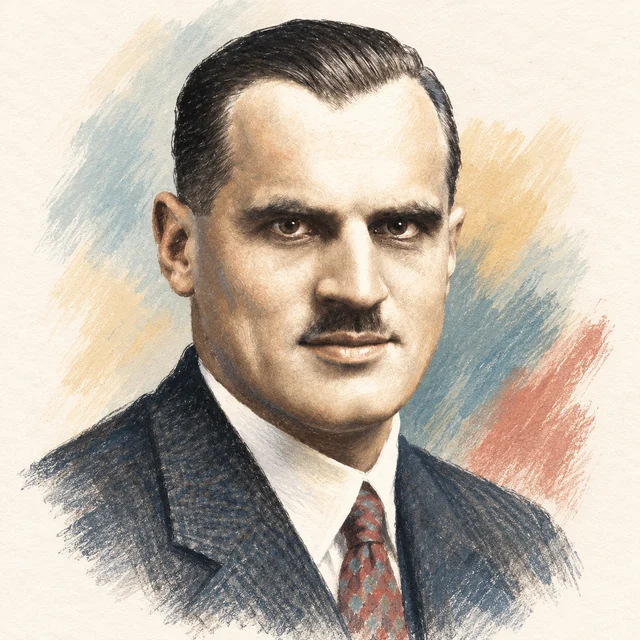
Compton grew up in an academic family in Wooster, Ohio, and graduated from the College of Wooster in 1913. He completed his doctorate at Princeton in 1916, then worked in teaching and industrial research before studying at Cambridge. He became a professor at Washington University in St. Louis in 1920 and moved to the University of Chicago in 1923. His investigations of X-ray scattering revealed a wavelength change in 1922 that could be explained by an exchange of energy and momentum between a photon and an electron. Wilson’s cloud chamber supplied evidence of the recoiling electrons, connecting a new account of radiation with a new experimental instrument. Compton received half the 1927 Physics Prize for the effect named after him. Later he organized studies of cosmic rays and played a major role in the wartime atomic-energy program. Those later activities were distinct from the Nobel-recognized scattering work. He returned to Washington University as chancellor in 1945 and died in 1962.
The contribution
Compton received half the Physics Prize for discovering the Compton effect. His scattering measurements supported an account in which an X-ray photon transfers energy and momentum to an electron.
The idea in plain language
When X-rays scatter from matter, part of the scattered radiation can have a longer wavelength than the incoming beam. Compton’s measurements and explanation connected that change with energy and momentum transferred from a photon to a recoiling electron. This supported the particle properties of light without abolishing its wave behaviour.
Read the full award story ↗