A life in context
The person behind the prize
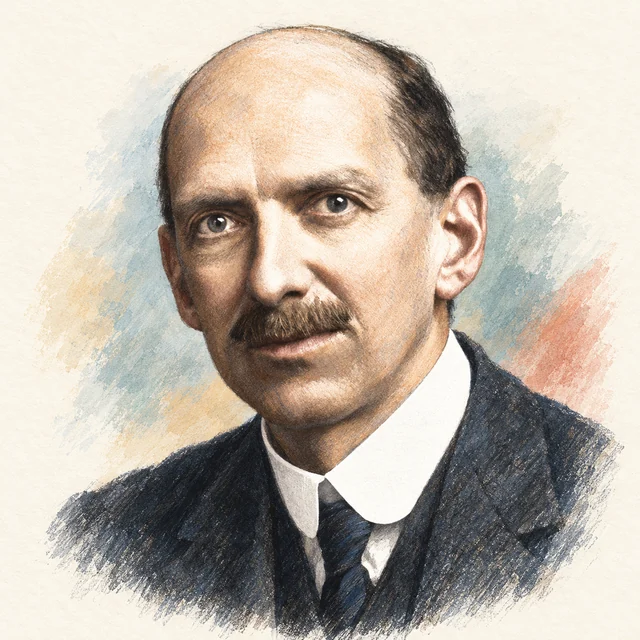
Wilson was born near Edinburgh and grew up in Manchester, where he initially studied biological subjects with medicine in mind. He entered Sidney Sussex College, Cambridge, in 1888 and graduated in 1892. A visit to Ben Nevis in 1894 stimulated his interest in clouds and optical phenomena in mist. Laboratory studies of condensation then led him to investigate how ions could become centres for water droplets. In 1911 he saw and photographed tracks left by individual charged particles; refinements in 1923 made the method especially valuable for studying electrons. What became visible was a trail of droplets, not a magnified photograph of the particle itself. His chamber helped establish the existence of Compton recoil electrons and became a foundation for later discoveries in particle physics. Wilson became Jacksonian Professor at Cambridge in 1925 and received half the 1927 Physics Prize. Atmospheric electricity remained another enduring interest. After retirement he returned to Scotland and continued scientific work until late in life, dying in 1959.
The contribution
Wilson received half the Physics Prize for a method that made charged-particle paths visible through condensation. His cloud chamber recorded droplet tracks along ionized paths, including recoil-electron tracks associated with the Compton effect.
The idea in plain language
When X-rays scatter from matter, part of the scattered radiation can have a longer wavelength than the incoming beam. Compton’s measurements and explanation connected that change with energy and momentum transferred from a photon to a recoiling electron. This supported the particle properties of light without abolishing its wave behaviour.
Read the full award story ↗