A life in context
The person behind the prize
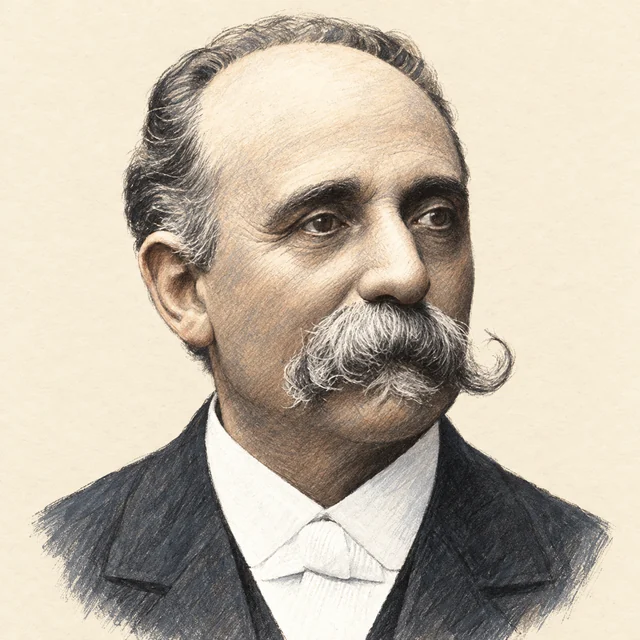
Camillo Golgi studied medicine at the University of Pavia, graduating in 1865. Work with Giulio Bizzozero encouraged the use of microscopic anatomy to investigate disease. In 1872 he became chief physician at the hospital for the chronically ill in Abbiategrasso. Limited facilities did not stop his research: a small improvised laboratory helped produce the staining method known as the black reaction in 1872–1873. The method deposited a dark silver compound in a small selection of nerve cells, allowing their cell bodies and branching processes to stand out against otherwise difficult tissue. Revealing a few complete cells could be more informative than colouring a dense mass of overlapping structures. Golgi later returned to an academic career at Pavia, teaching and directing laboratory research. His investigations extended beyond nervous tissue. He studied malaria and the relationship between the parasite’s development and recurring fever, work that belonged to a larger international effort rather than a solitary discovery of the disease. In 1898 he described the intracellular structure subsequently called the Golgi apparatus. That organelle is a separate contribution from the research on nervous-system structure honoured in 1906. Golgi interpreted nerve tissue through a reticular theory, favouring continuity in the network. Santiago Ramón y Cajal, who adapted Golgi’s staining method, argued instead for distinct nerve cells making contacts. They shared the 1906 Medicine Prize equally despite this important disagreement. Golgi’s method and observations remained valuable even as the neuron doctrine gained support. He became a senator in 1900, remained active in Pavia and died there in 1926. His career connects medical practice, inventive preparation of specimens and the difficulty of separating what a microscope reveals from the theory used to explain it.
The contribution
Golgi received half the Medicine Prize for work on the structure of the nervous system. His black reaction made a small number of nerve cells and their extensive branches visible in tissue.
The idea in plain language
Golgi’s black reaction stains a small selection of nerve cells darkly, exposing cell bodies and long, fine processes against a relatively clear background. Instead of colouring everything, selective visibility lets an observer follow the shape of a few cells through complicated tissue.
Read the full award story ↗