A life in context
The person behind the prize
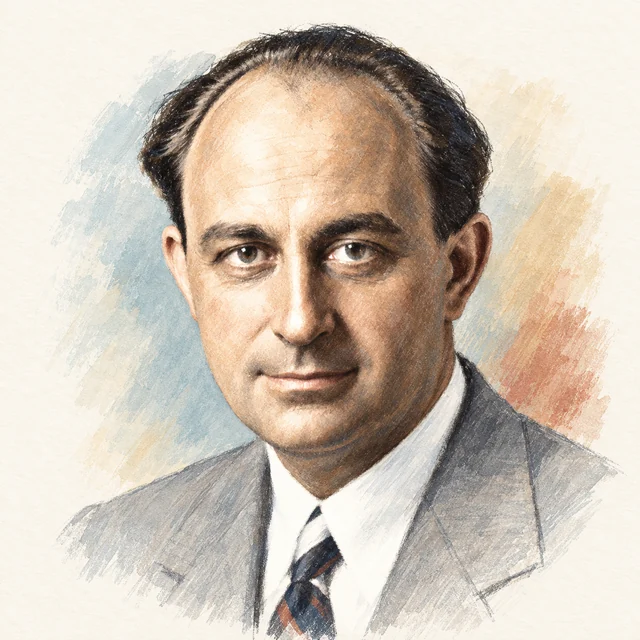
Fermi received his physics doctorate at Pisa in 1922, studied with Max Born and Paul Ehrenfest, and taught in Florence before taking up the theoretical-physics chair in Rome in 1926. His work ranged from quantum statistics to a theory of beta decay. In 1934 his Roman group turned to neutron-induced radioactivity. Collaborators included Amaldi, Pontecorvo, Rasetti, Segrè and the chemist D’Agostino. Their observations led to a particularly important result: slowing neutrons could greatly increase the probability of some nuclear reactions. The uranium experiments also produced complicated activities whose interpretation as new transuranic elements was not a secure identification; fission products were part of the mixture. The whole 1938 Physics Prize recognised neutron-induced radioactivity and slow-neutron reactions. After collecting the prize in Stockholm, Fermi and his family left for the United States. Italy’s antisemitic laws threatened his wife Laura, who was Jewish, and their family. He joined Columbia in 1939. His later leadership of the first controlled, self-sustaining nuclear chain reaction at Chicago in December 1942 was a subsequent achievement, not the experiment cited in 1938.
The contribution
Fermi received the whole Physics Prize for neutron-induced radioactivity and reactions brought about by slow neutrons. The experimental programme was collaborative, and its early uranium-product interpretation required later correction.
The idea in plain language
How could researchers investigate nuclei without relying only on charged projectiles? A neutron has no electric charge, so it does not face the same electrostatic repulsion as a positively charged projectile approaching a nucleus. In 1934 Fermi and his Roman collaborators explored the radioactivity produced when elements were exposed to neutrons. Chemical separation and radiation measurements helped them investigate the products.
Read the full award story ↗

