A life in context
The person behind the prize
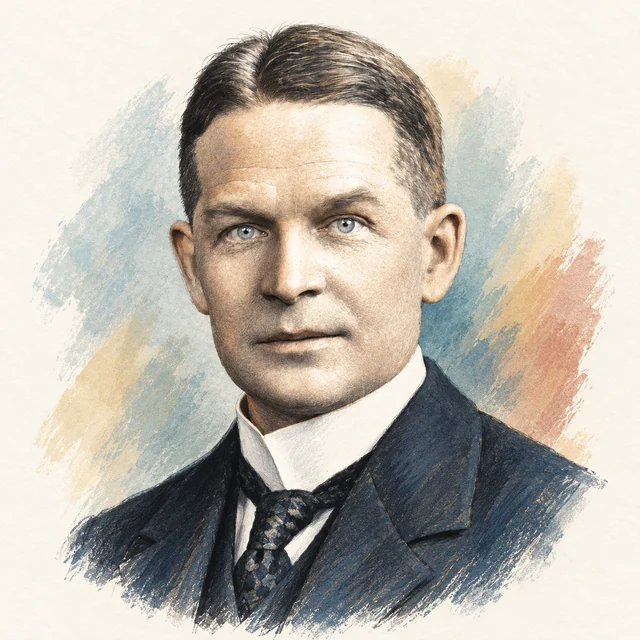
Soddy was born in Eastbourne and studied at Oxford. At McGill in Montreal from 1900 to 1902, he worked with Ernest Rutherford on radioactivity and the transformation of atoms. Subsequent work with William Ramsay connected helium with radioactive change. At Glasgow, where he worked from 1904 to 1914, the growing number of radioactive substances raised a classification problem: some could not be separated chemically even though their radioactive behaviour differed. Soddy helped explain how different atomic varieties could occupy the same place in the periodic table. In 1913 he introduced the term isotope and developed the displacement interpretation of radioactive changes. He moved to Aberdeen in 1914 and became a professor at Oxford in 1919. The 1921 Chemistry Prize was reserved and awarded to him in 1922 for the chemistry of radioactive substances and investigations into the origin and nature of isotopes. Oxford was his official award affiliation. His work provided an interpretation of atomic identity; it should be distinguished from Aston’s mass-spectrograph measurements recognised in 1922. He also wrote about economic and social questions, a later sphere of activity separate from the Nobel citation. He retired in 1937 and died in Brighton in 1956.
The contribution
Soddy received the full Chemistry Prize for work on radioactive substances and the origin and nature of isotopes. He helped show why chemically inseparable atomic varieties could belong to one element, and how radioactive changes relate to positions in the periodic table.
The idea in plain language
Radioactivity produced a confusing collection of substances. Some behaved differently in radioactive changes but could not be separated by ordinary chemical methods. Treating every radioactive preparation as a new chemical element made the periodic table harder to understand.
Read the full award story ↗

