A life in context
The person behind the prize
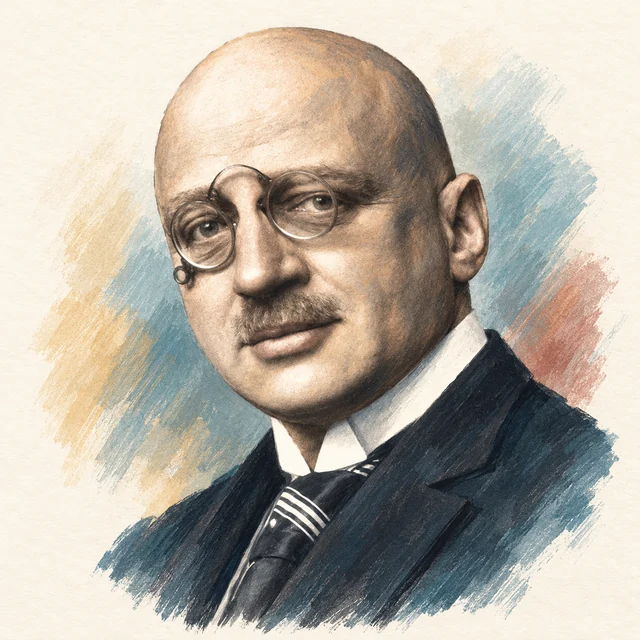
Haber was born in Breslau, then in Prussia, and studied chemistry in Heidelberg, Berlin and Charlottenburg. He joined the technical university in Karlsruhe in 1894 and became professor of physical chemistry and electrochemistry in 1906. His aim of connecting chemical understanding with industrial problems led him to the reaction of nitrogen and hydrogen to make ammonia. With Robert Le Rossignol he developed laboratory apparatus capable of demonstrating the synthesis; the Science Museum preserves a sample associated with the demonstration of 2 July 1909. Turning that achievement into large-scale production required further work led by Carl Bosch and colleagues at BASF, whose first industrial plant opened in 1913. Haber became the first director of the newly founded Kaiser Wilhelm Institute for Physical Chemistry and Electrochemistry in 1911, his award institution. During the First World War he also directed the large-scale use of chemical weapons for the German military in 1915. His institute’s own historical account addresses that responsibility; the ammonia award cannot be treated as approval of his wartime actions. The reserved 1918 Chemistry Prize was announced on 13 November 1919 and presented on 1 June 1920. In 1933 he resigned rather than carry out Nazi instructions to dismiss Jewish members of his staff, and went into exile. He died in Basel in 1934. His career combines an influential chemical contribution, collaboration and industrial engineering, and grave military responsibility.
The contribution
Haber received the full Chemistry Prize for synthesising ammonia from nitrogen and hydrogen. His physical-chemical investigations and laboratory work with Le Rossignol established a workable synthesis; Bosch and the BASF team carried out the industrial scale-up.
The idea in plain language
The atmosphere contains abundant nitrogen, yet most plants need nitrogen in chemically usable compounds. Making ammonia directly from nitrogen and hydrogen offered a route to an important starting material for fertilisers. The reaction presented a linked problem of equilibrium and speed: conditions favouring ammonia were not automatically conditions in which it formed fast enough for practical production.
Read the full award story ↗

