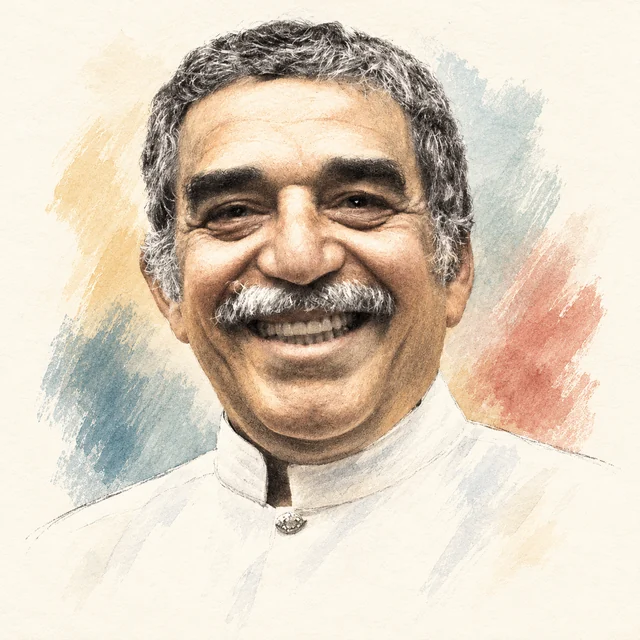
A life in context
The person behind the prize
García Márquez grew up in northern Colombia with his maternal grandparents, whose stories and memories helped shape his imagination. He began law studies but turned to journalism and fiction, later working and living in several countries before settling in Mexico. Leaf Storm appeared in Spanish in 1955; No One Writes to the Colonel in 1961. One Hundred Years of Solitude, published in 1967, brought an international readership to the fictional town of Macondo and its generations of inhabitants. The Autumn of the Patriarch followed in 1975 and Chronicle of a Death Foretold in 1981. His career also included journalism and screenwriting. Love in the Time of Cholera appeared in 1985, after the Nobel Prize, and belongs to the later continuation of his work.
The contribution
García Márquez combined fantastic events with closely observed social worlds, giving memory, family, violence and power an expansive narrative form. The Literature Prize recognised his novels and short stories as a body of work. Macondo is a fictional setting, not a documentary location, and the award was broader than the success of one novel.
The idea in plain language
In One Hundred Years of Solitude, the fictional town of Macondo and successive generations create a world where ordinary events and extraordinary occurrences share a narrative voice. Family stories, repetitions and uncertain memory shape the reader’s sense of time. The fantastic does not remove politics or material conditions: war, power and economic change remain part of the world.
Read the full award story ↗

