A life in context
The person behind the prize
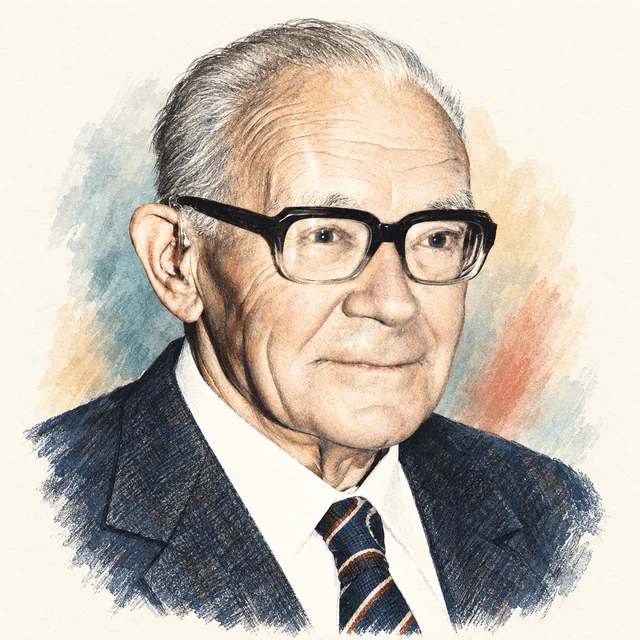
Wittig trained and qualified as a university teacher in Marburg, then worked in Braunschweig, Freiburg and Tübingen before moving to Heidelberg. His research followed unusual reactions of carbon compounds with alkali metals, including halogen–metal exchange and reactive intermediates. Investigating compounds containing phosphorus led him to phosphorus ylides. In 1953 he developed a reaction in which a carbonyl compound and a phosphorus ylide form a carbon–carbon double bond, with a phosphorus oxide as a coproduct. The result gave synthetic chemists a new way to build molecular structures, including steps used in vitamin synthesis. He became emeritus in 1967 and remained associated with Heidelberg at the award.
The contribution
Wittig developed phosphorus-containing reagents that convert carbonyl groups into alkenes while joining carbon fragments. He received one half of the Chemistry Prize. The reaction complements Brown’s boron chemistry; it is a distinct method with its own conditions and products.
The idea in plain language
Brown investigated how boron-containing compounds could serve as selective reducing agents and synthetic intermediates. In hydroboration, a boron–hydrogen bond adds across a carbon–carbon double bond, producing a carbon–boron bond. Further reactions can replace that boron-containing part with other groups. Work with B. C. Subba Rao and later collaborators transformed an unexpected experimental result into a useful family of methods.
Read the full award story ↗