A life in context
The person behind the prize
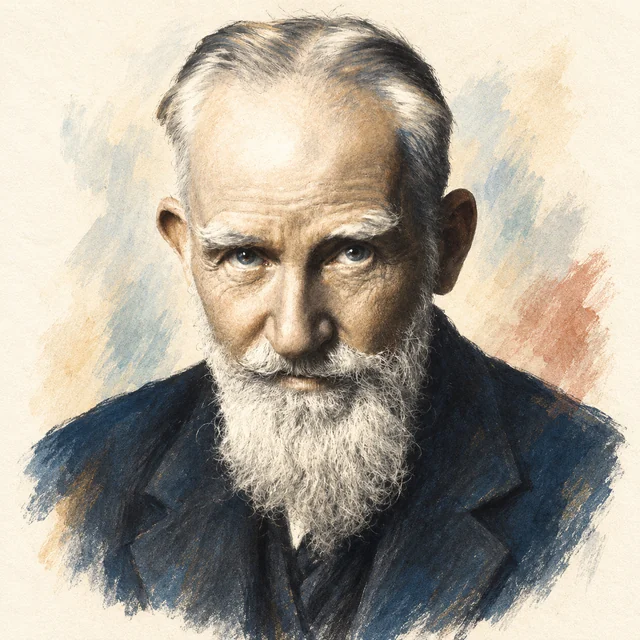
Shaw was born in Dublin and moved to London in 1876 after work in an estate agent’s office. His early novels found little success, but he established himself as a music and theatre critic and became a prominent member of the Fabian Society. Advocacy of Ibsen’s drama helped lead him towards plays that questioned the assumptions of respectable society. He used argument, wit and reversals of expectation to expose contradictions in attitudes to poverty, class, gender and power. Man and Superman, Major Barbara and Saint Joan show different ways in which theatre could become a forum for ideas without abandoning dramatic conflict. He received the full 1925 Literature Prize, awarded in 1926, for his wider literary achievement rather than for one play alone. His political record also included advocacy of eugenics and admiration for authoritarian leaders; the literary award should not be read as endorsement of those positions. He continued writing long after the prize and died in 1950. His plays and their extensive prefaces remain distinct but closely connected parts of his work.
The contribution
Shaw received the full Literature Prize for writing combining idealism, humanity, stimulating satire and poetic qualities. His plays and prefaces used wit and argument to challenge inherited social assumptions.
The idea in plain language
A play can make an audience laugh while asking why respectable institutions tolerate injustice. Shaw brought arguments about class, poverty, morality and power into encounters between characters. Opposing viewpoints become part of the dramatic action rather than simply a lesson delivered by an author.
Read the full award story ↗

