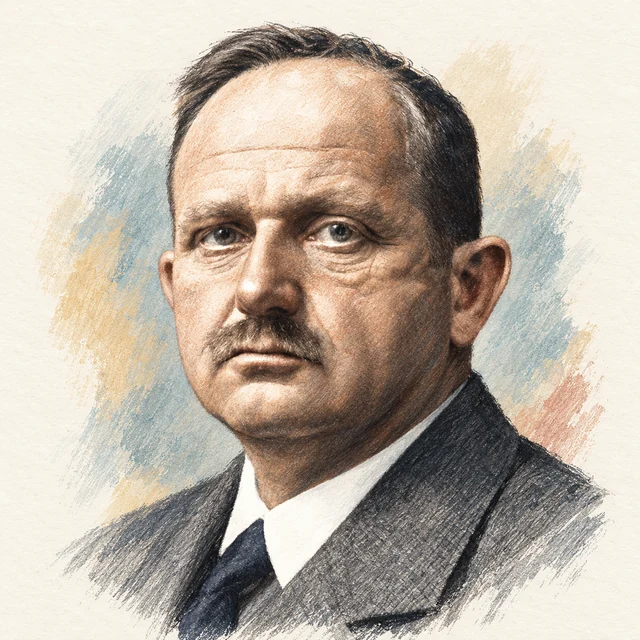
A life in context
The person behind the prize
Fischer studied chemistry and medicine in Lausanne and Marburg, completing a chemistry degree in 1904 and later medical training in Munich, including his medical doctorate in 1908. He worked in clinical and chemical laboratories, including Emil Fischer’s Berlin laboratory, before appointments in Innsbruck and Vienna. In 1921 he became professor of organic chemistry at Munich’s Technische Hochschule. His investigations centered on the structure of natural pigments in blood, bile and leaves, with pyrrole and porphyrin chemistry providing a common thread. Analysis of breakdown products and the synthesis of proposed structures helped establish how these complicated compounds were assembled. His synthesis of haemin in 1929 was especially important to the 1930 Chemistry Prize. Haemin is related to the haem pigment framework; making it did not synthesize the globin protein, whole haemoglobin or artificial blood. Work on chlorophyll formed another major part of the award, without implying that its complete synthesis had already been achieved. Fischer died in Munich in 1945.
The contribution
Fischer received the full Chemistry Prize for structural research on haemin and chlorophyll, especially the synthesis of haemin. Analytical breakdown and chemical reconstruction tested the proposed architecture of natural pigments.
The idea in plain language
Haemoglobin contains globin protein and iron-containing haem groups. Haemin is a related compound used in investigating the pigment framework. Its complicated structure could not be established simply from its red color. Fischer examined smaller products obtained by breaking the pigment down and investigated the chemistry of pyrroles and porphyrins, connecting many separate observations.
Read the full award story ↗

