A life in context
The person behind the prize
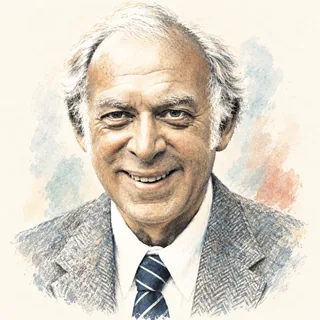
Kendall grew up in Massachusetts and served in the Merchant Marine before studying mathematics and physics at Amherst. Graduate research at MIT with Martin Deutsch concerned atomic physics and positronium. Work in Hofstadter’s Stanford group introduced him to nuclear electron scattering; he later returned to MIT. He was also a mountaineer and underwater photographer, interests that accompanied a career of demanding experimental work.
The contribution
Kendall helped develop the MIT–SLAC scattering programme and the apparatus and analysis needed to test nucleon structure. He and Friedman developed radiative-correction work, combining their approaches as the collaboration progressed. Measurements of scattered electron energies and angles challenged a smooth, structureless picture of nucleons and supported the quark model. The result belonged to a collaboration across two laboratories; Kendall received one third of the prize.
The idea in plain language
Protons and neutrons had once been treated as elementary particles, but competing models proposed an internal structure. The MIT–SLAC collaboration used high-energy electrons to test that structure. Unlike elastic scattering, deep-inelastic events transfer enough energy to excite or break up the target. The team recorded the outgoing electrons’ energies and angles from proton targets and from targets containing bound neutrons.
Read the full award story ↗