The organisation
A collective voice
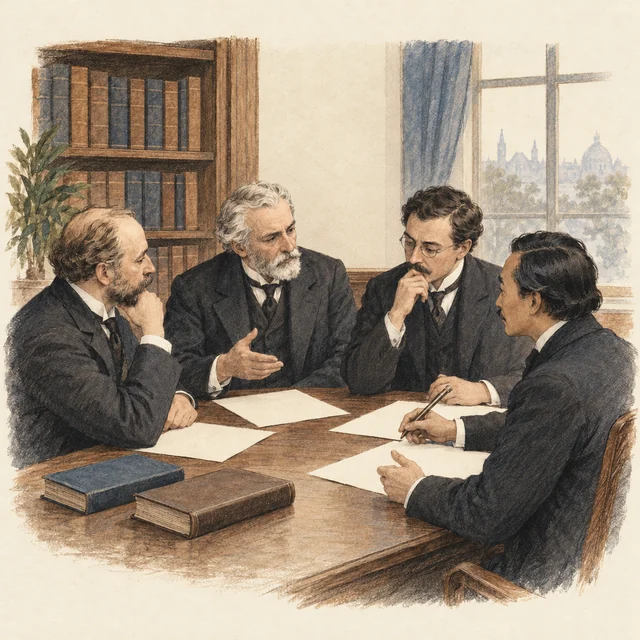
The Institute of International Law was founded at Ghent in 1873 as an independent learned society, not a government, court or association of states. The Belgian jurist Gustave Rolin-Jaequemyns initiated the project with ten other founders. They included Tobias Asser, Gustave Moynier and Johann Caspar Bluntschli; Pasquale Stanislao Mancini became its first president. The aim was to bring legal expertise to problems that crossed state boundaries and to make international law a more systematic guide to relations between nations. Members examined questions, prepared reports and debated resolutions. Its first regular session followed at Geneva in 1874, and publication of its Yearbook began in 1877. The subjects extended beyond the prevention of war to questions such as nationality, jurisdiction and private international law. At Oxford in 1880 the Institute adopted a manual on the laws of land warfare. The existence of that resolution is documented in the Institute’s session index; it was a scholarly contribution, not a treaty automatically binding every state. Study of arbitration and the laws of war contributed to the discussions that led to the Hague Peace Conference of 1899. Such influence worked through legal argument, governments and other institutions, rather than the Institute possessing enforcement power of its own. The full 1904 Peace Prize recognised the organisation’s efforts to develop peaceful ties through public law and to make wartime rules more humane. It was an organisational award, not an individual prize to one founder. The work represented selected jurists and the assumptions of their historical setting, not a legislature elected by all the world’s peoples. No presentation speech was delivered for the 1904 award. The historical welcome address linked on NobelPrize.org belongs to a later Institute visit in 1912 and must not be read as a record of a 1904 ceremony. The Institute’s history demonstrates one route by which organised scholarship can shape international practice, while also showing the distance between proposing legal standards and securing their observance.
The contribution
The Institute received the full Peace Prize for developing peaceful legal relations between nations and more humane laws of war. Independent legal research, resolutions and advocacy supported arbitration and international rule-making.
The idea in plain language
Founded at Ghent in 1873, the Institute organised legal study across national boundaries. Members prepared reports, debated principles and adopted resolutions on subjects including nationality, jurisdiction, arbitration and warfare. Publishing arguments made them available to officials and other lawyers beyond a single meeting.
Read the full award story ↗

