A life in context
The person behind the prize
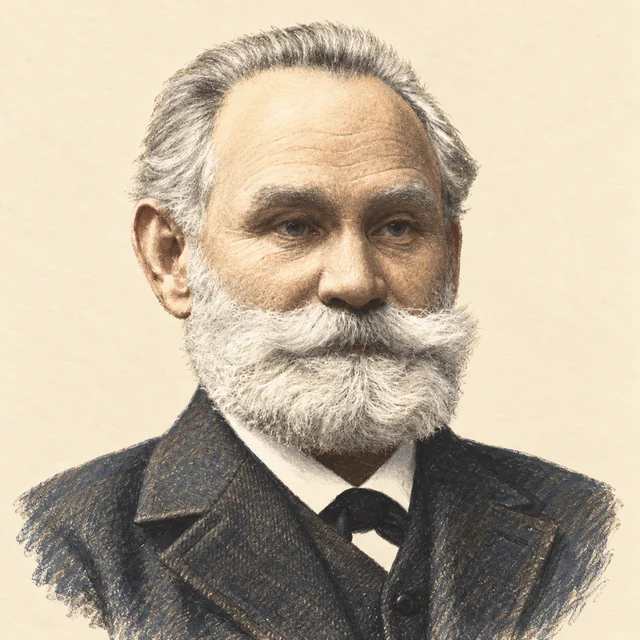
Ivan Pavlov began his education in religious schools in Ryazan but turned towards the natural sciences, entering St. Petersburg University in 1870. Early research included work with Afanasyev on pancreatic nerves. He completed his natural-science studies in 1875, then pursued medical training, qualifying in 1879. His 1883 doctoral work concerned nerves of the heart, and further study in Germany broadened his experimental experience. He married Seraphima Karchevskaya in 1881. In 1890 he took responsibility for physiology at the Institute of Experimental Medicine in St. Petersburg and also held a chair at the Military Medical Academy. He moved to the academy’s physiology chair in 1895. The digestion studies developed through a research school of colleagues and students, rather than one investigator working alone. Pavlov sought to study digestive organs as parts of a coordinated living system. Different foods, sensory cues and nervous pathways influenced the flow of digestive secretions and the movements associated with digestion. His 1897 book on the digestive glands brought much of the work together. Experiments with dogs depended on invasive surgical preparations. Contemporary Nobel accounts praised their usefulness and described the animals as remaining healthy, but those statements do not settle modern questions about animal welfare; the physiological knowledge and the ethical costs both belong in the history. The full 1904 Medicine Prize recognised his work on the physiology of digestion. The conditioned responses for which he later became especially famous grew from this setting, including observations of secretion in anticipation of food. They should not replace digestion as the subject of the prize, or be reduced to a story about a single bell. He publicly discussed conditioned reflexes in Madrid in 1903 and continued developing the research afterwards. Pavlov died in Leningrad in 1936. His lasting contribution joined controlled observations with questions about how organs, nerves and the animal’s encounters with its surroundings work together.
The contribution
Pavlov received the full Medicine Prize for research on digestive physiology. His school investigated how nervous activity, food and sensory experience regulate digestive secretions and other aspects of digestion.
The idea in plain language
Earlier investigations could isolate a digestive substance or examine an organ, but relating those findings to the coordinated activity of a living animal was difficult. Pavlov and his colleagues developed ways to observe digestive secretions over time and compare responses to different foods and circumstances. The work involved invasive animal experiments.
Read the full award story ↗