A life in context
The person behind the prize
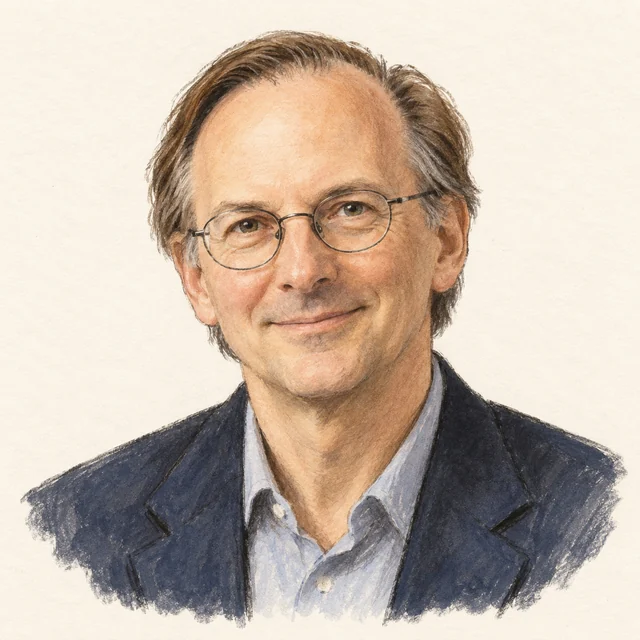
Szostak was born in London and grew up in Canada. He studied at McGill University and received his doctorate at Cornell in 1977, joining Harvard Medical School in 1979. His yeast experiments raised a practical puzzle: introduced linear DNA was unstable and quickly degraded. A meeting with Elizabeth Blackburn connected that problem with her observations of repeated DNA at the ends of Tetrahymena chromosomes.
The contribution
Szostak and Blackburn tested whether Tetrahymena end sequences could protect linear DNA in yeast. Their 1982 results showed that the protective function could work across these distant organisms. Szostak’s group also studied yeast mutations that disrupted telomere maintenance and eventually impaired cell proliferation. These experiments helped establish chromosome-end protection as a general biological problem with a molecular solution.
The idea in plain language
The end of a chromosome presents two problems. It must be protected from degradation or mistaken repair, and ordinary DNA copying has difficulty reproducing the very end of a linear molecule. Blackburn studied repeated DNA at the ends of Tetrahymena chromosomes. With Szostak, she showed that these sequences could protect linear DNA introduced into yeast, revealing a function that crossed distant species.
Read the full award story ↗