A life in context
The person behind the prize
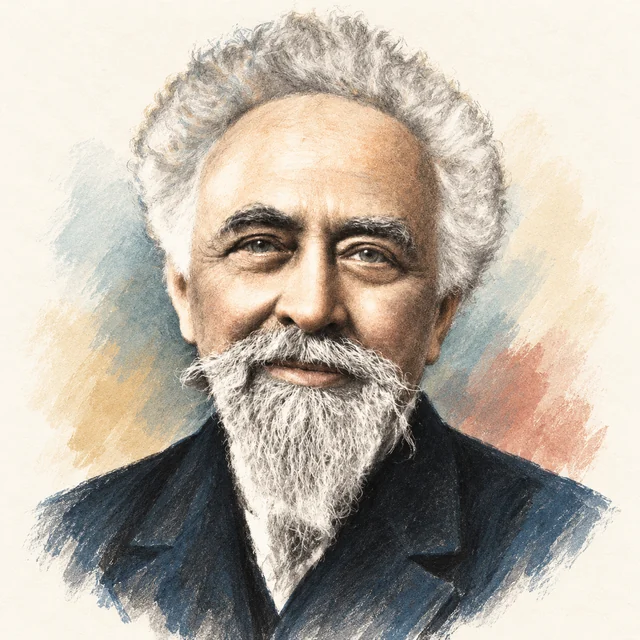
Perrin was born in Lille and studied at the École Normale Supérieure before completing his doctorate in 1897. He became a reader at the Sorbonne that year and a professor of physical chemistry in 1910. His early research concerned cathode rays, but the work recognised by the Nobel Prize addressed a deeper dispute: whether atoms and molecules were physical realities or merely convenient descriptions. In 1908 he studied tiny suspended grains, measuring their distribution at different heights and their irregular motion. Agreement between independent ways of estimating the number of molecules strengthened the case for the molecular account of matter. The grains were visible under a microscope; the molecules striking them were not. Perrin developed these ideas for a wider readership in Les Atomes, published in 1913. He received the full 1926 Physics Prize while at the Sorbonne. He later helped build French scientific institutions, went to the United States in 1940 and died in New York in 1942.
The contribution
Perrin received the full Physics Prize for work on the discontinuous structure of matter, especially sedimentation equilibrium. Measurements of suspended grains tested molecular theory and gave consistent estimates of molecular numbers.
The idea in plain language
At the start of the twentieth century, molecular explanations were powerful but not universally accepted as descriptions of physical reality. Perrin used very small suspended grains as observable probes. Their irregular Brownian motion could be understood as the result of many unequal impacts from the surrounding liquid’s molecules.
Read the full award story ↗

