A life in context
The person behind the prize
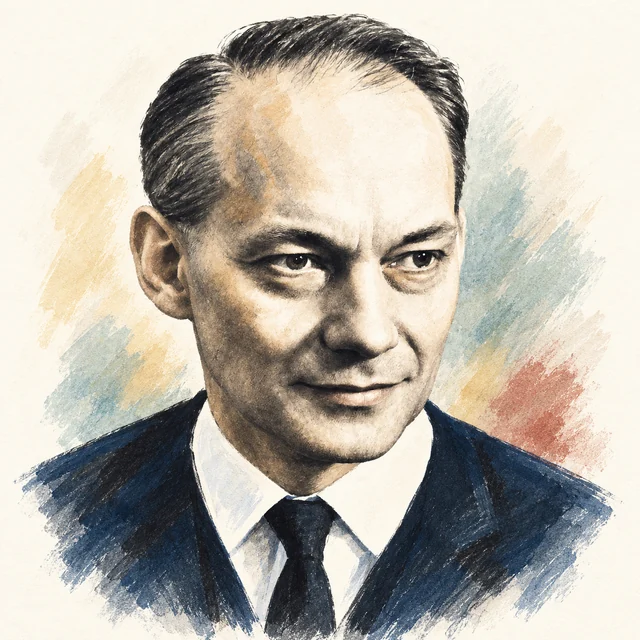
Eigen began studying physics and chemistry at Göttingen in 1945 and earned his doctorate in 1951, studying heavy water and electrolyte solutions. He moved to the Max Planck Institute for Physical Chemistry in 1953. Ultrasound absorption encouraged his work on fast ionic reactions; he developed relaxation methods that disturb an equilibrium and follow the response. Leo de Maeyer, who joined in 1954, was a major collaborator in developing methods and investigating proton reactions. Eigen became a scientific member in 1957, head in 1964 and managing director in 1967. His research broadened toward organic and biological chemistry. The prize recognised methods for examining extremely fast reactions, with Göttingen as his award affiliation.
The contribution
Eigen developed relaxation methods for studying very fast chemical reactions. He received one half of the Chemistry Prize.
The idea in plain language
Some chemical transformations happen before ordinary mixing and sampling can reveal their steps. Eigen developed methods that perturb an equilibrium very rapidly, then follow the system’s relaxation. Ultrasound, electrical changes and temperature jumps offered different ways to investigate fast processes.
Read the full award story ↗