A life in context
The person behind the prize
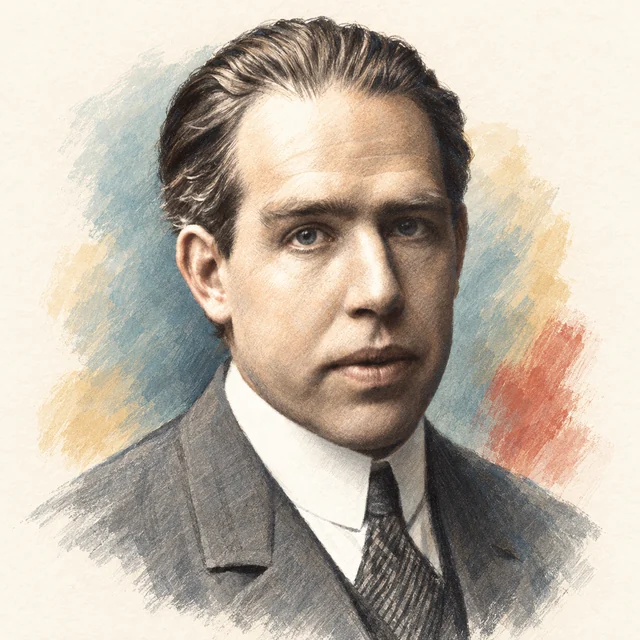
Bohr grew up in Copenhagen in a family closely connected with science and education. He studied physics at Copenhagen University, receiving his doctorate in 1911, then worked in Cambridge and in Rutherford’s laboratory in Manchester. Rutherford’s nuclear atom posed a problem: ordinary electromagnetic theory could not explain its stability and the sharp lines in atomic spectra. In 1913 Bohr proposed allowed stationary states and related light emission to changes between them. The hydrogen spectrum became a quantitative test of this new combination of atomic structure and quantum ideas. After teaching in Copenhagen and Manchester, he became professor of theoretical physics in Copenhagen in 1916. The institute established there in 1921 grew into a meeting place for researchers developing quantum physics. The full 1922 Physics Prize recognised his investigations of atoms and their radiation. His later work on complementarity and nuclear physics went beyond that award. During the Second World War he escaped occupied Denmark; afterwards he advocated international openness about atomic questions. He died in Copenhagen in 1962.
The contribution
Bohr received the full Physics Prize for investigating atomic structure and atomic radiation. His theory connected allowed atomic energies with the light emitted in transitions, explaining important regularities in hydrogen’s spectrum.
The idea in plain language
Why does a gas emit particular colours instead of every possible colour? A nuclear atom treated by ordinary classical theory did not explain both stability and the observed pattern of light. In 1913 Bohr proposed that an atom could occupy certain stationary states. In the model, an electron did not continually radiate while remaining in one of those allowed states.
Read the full award story ↗

