A life in context
The person behind the prize
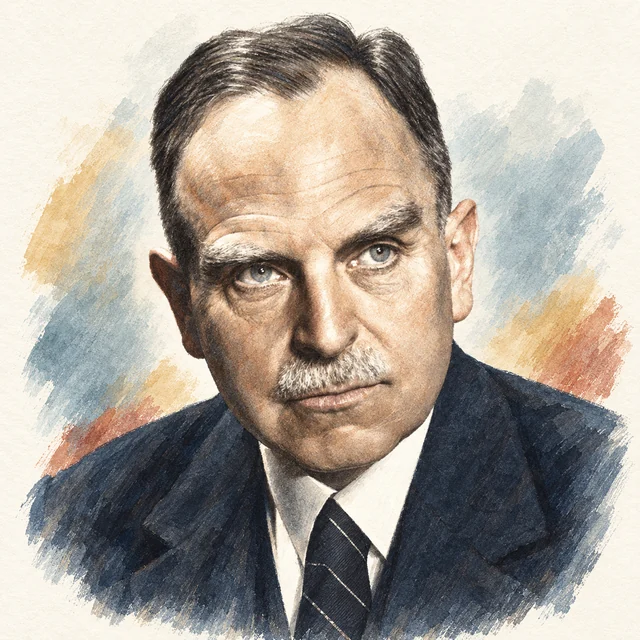
Hahn trained as a chemist at Marburg, receiving his doctorate in 1901. Work with William Ramsay in London in 1904–1905 and Ernest Rutherford in Montreal in 1905–1906 introduced him to radioactive substances and their transformations. He returned to Berlin in 1906, began a long collaboration with Lise Meitner in 1907 and became director of the Kaiser Wilhelm Institute for Chemistry in 1928. At the end of 1938, his chemical experiments with Fritz Strassmann identified barium among products formed when uranium was irradiated with neutrons. Meitner, who had fled Nazi antisemitic persecution in 1938, and Otto Robert Frisch supplied the physical interpretation of a heavy nucleus splitting. The experimental and theoretical contributions were connected, but the Nobel award named Hahn alone. His 1944 Chemistry Prize was reserved that year, announced in November 1945 and physically presented to him in Stockholm in December 1946. Leadership of the Kaiser Wilhelm Society from 1946 and the Max Planck Society from 1948 came later; the institute should retain its award-era name here.
The contribution
Hahn received the whole Chemistry Prize for the discovery of fission of heavy nuclei. The chemical evidence was obtained with Strassmann; Meitner and Frisch provided its physical interpretation.
The idea in plain language
When uranium was exposed to neutrons, what new substances were being formed? The products were difficult to untangle, and the expected kinds of nuclear transformation did not readily account for what the chemical tests showed. At the end of 1938 Hahn and Strassmann identified barium, a much lighter element, among the products.
Read the full award story ↗

