A life in context
The person behind the prize
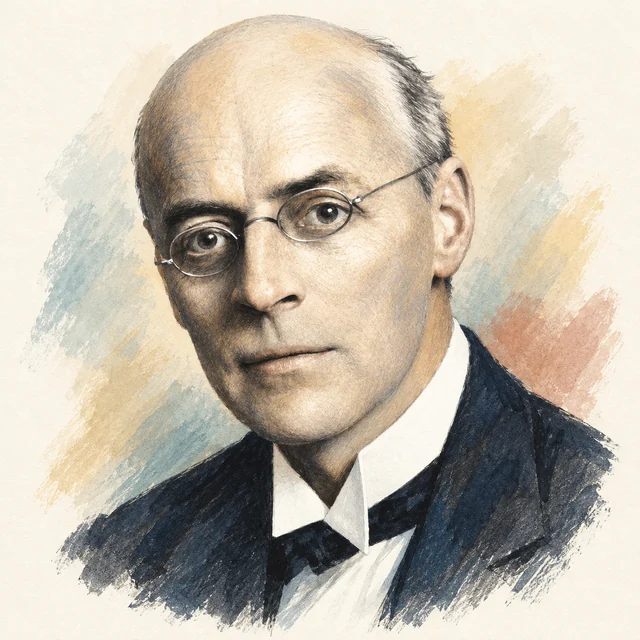
Richardson graduated at Cambridge in 1900 and began studying the electrical emission of hot bodies at the Cavendish Laboratory. In a paper presented in 1901 he proposed a temperature-dependent law for the current emitted by a heated metal. Years of experimental work tested whether the effect belonged to the metal’s electrons or arose from chemical reactions and impurities. He became a fellow of Trinity College in 1902 and taught at Princeton from 1906 to 1913. In 1914 he returned to Britain as Wheatstone Professor of Physics at King’s College within the University of London. His interests also included photoelectric effects, spectroscopy and quantum theory, which should not be collapsed into the specific thermionic work recognized by the prize. Richardson’s full Physics Prize belonged to 1928 but was announced and presented in 1929, after being reserved. It was separate from de Broglie’s 1929 award. He later held a Royal Society research professorship, was knighted in 1939 and died in 1959.
The contribution
Richardson received the full 1928 Physics Prize, awarded in 1929, for thermionic research and especially the law relating emission to temperature. He established an experimentally tested account of electrons escaping heated metals.
The idea in plain language
A hot metal can release electrons from its surface. The effect does not require light to knock them out, and it does not depend on air as the source of the electrons. Richardson treated it as an effect of the metal’s mobile electrons and investigated how the emitted current changes with temperature.
Read the full award story ↗

