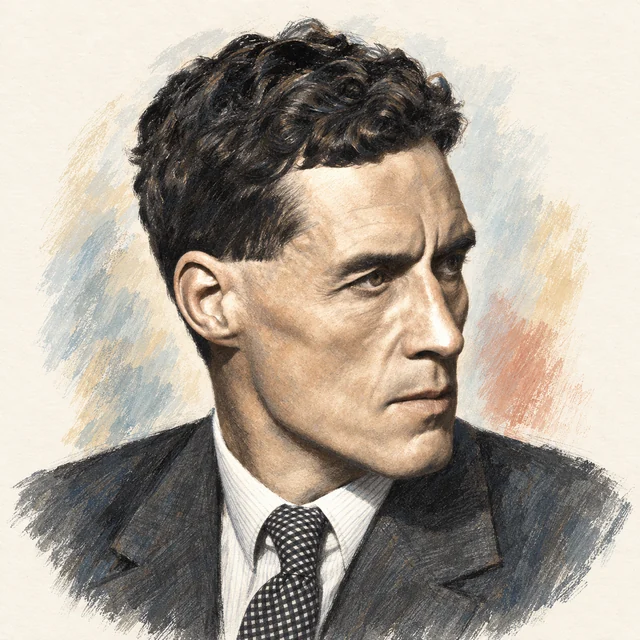
A life in context
The person behind the prize
Blackett trained for a naval career and served during the First World War before studying physics at Cambridge. He completed his BA in 1921 and worked with Rutherford at the Cavendish Laboratory. Early cloud-chamber photographs recorded nuclear transmutation, while a period with James Franck at Göttingen broadened his research experience. In 1932 he and Giuseppe Occhialini developed a counter-controlled cloud chamber that selected the moment to record a passing cosmic-ray event. Their 1933 studies of electron–positron pairs and showers helped establish how radiation could produce particles in matter. This work followed Anderson’s discovery of the positron rather than replacing his priority. Blackett held a London professorship from 1933 and moved to Manchester in 1937. During the Second World War he worked in scientific advice and operational research. Manchester was his affiliation for the full 1948 Physics Prize. His later appointment as head of physics at Imperial College in 1953, and later work on rock magnetism, belong to subsequent stages of his career.
The contribution
Blackett developed the Wilson cloud-chamber method, including counter control with Occhialini, and used it to investigate nuclear processes and cosmic radiation. He received the full Physics Prize; Wilson’s invention and collaborators’ contributions remain distinct.
The idea in plain language
How can an experiment record a particle that arrives at an unpredictable moment? Wilson’s cloud chamber made the path of a charged particle visible through droplets forming along the ionised trail. A photograph taken at the wrong time, however, could miss the event. Blackett and Giuseppe Occhialini connected particle counters to the chamber so that coincident signals helped select when it should operate.
Read the full award story ↗

