The organisation
A collective voice
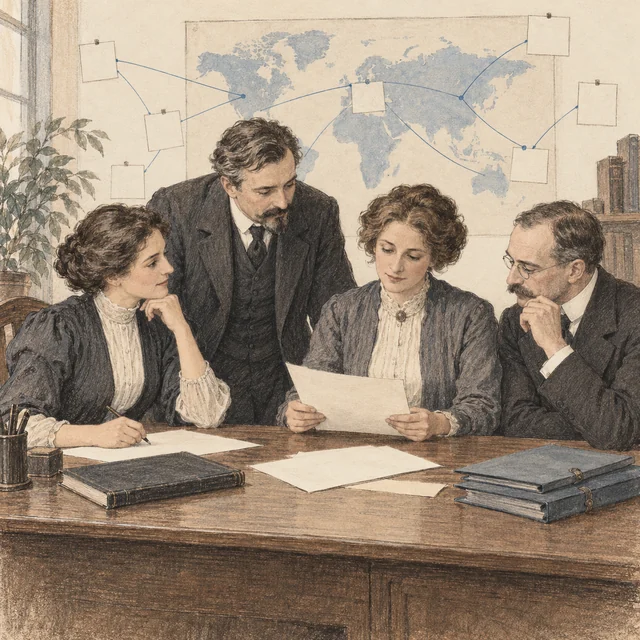
The Permanent International Peace Bureau emerged from the Universal Peace Congresses as a continuing office for cooperation between national peace societies. Founded in Bern in 1891, it linked organisations that otherwise met only intermittently. Fredrik Bajer was its first president and Élie Ducommun its first secretary-general; after Ducommun’s death in 1906, Albert Gobat continued the secretarial work. Henri La Fontaine was president at the time of the 1910 award. These people’s individual Nobel Prizes were separate from the full prize awarded to the organisation itself. The Bureau exchanged information, maintained records and a library, published a periodical and yearbook, and helped prepare congresses and follow up their decisions. Its programme supported arbitration, disarmament and peaceful settlement through international arrangements. Limited resources and dependence on voluntary cooperation constrained its influence, and it could not prevent the First World War. It moved its office to Geneva in 1924. The Second World War disrupted its activity; postwar reconstruction involved a new liaison committee, legal succession recognised in 1961 and readoption of the IPB name in 1964. Those later changes should not be projected back onto the Bern office of 1910. The Nobel presentation survives as a translated contemporary newspaper account, and no Nobel lecture was delivered for this award.
The contribution
The Bureau received the full Peace Prize for connecting peace societies across countries and helping organise international peace congresses. The recipient was the organisation, not a single officer or a compulsory authority over governments.
The idea in plain language
National peace societies differed in membership, priorities and local circumstances. A congress could bring them together, but correspondence, records and preparation were needed between meetings. The Bureau, founded in Bern in 1891, supplied a continuing point of contact. It maintained information and a library, published a periodical and yearbook, prepared congresses and followed up their decisions.
Read the full award story ↗

