A life in context
The person behind the prize
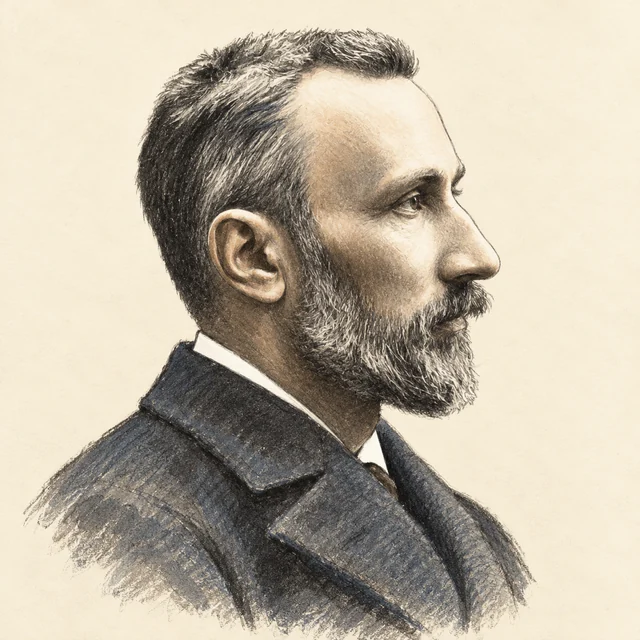
Pierre Curie was educated at home in Paris before studying physics at the Sorbonne. His early research combined close observation with the construction of precise instruments. In 1880 he and his brother Jacques discovered piezoelectricity: mechanical stress on certain crystals can produce electric charge. Pierre joined the municipal school of industrial physics and chemistry in 1882, investigated crystal symmetry and magnetism, and developed sensitive measuring apparatus. His doctoral work on magnetic properties was completed in 1895, the year he married Marie Skłodowska. Marie’s investigation of uranium radiation became the starting point for their shared work on radioactive substances. An electrical measurement of the ionisation produced by radiation offered a way to compare activity, rather than relying only on a photographic impression. Some uranium-bearing minerals were more active than their uranium content could explain. Treating that excess as evidence for another constituent, the researchers followed activity through chemical separation. In 1898 Marie and Pierre announced polonium, and their announcement of radium also involved Gustave Bémont. These discoveries concerned evidence for new elements and their compounds; they were not the production of pure radium metal, achieved later by Marie Curie and André Debierne. Pierre also studied the physical effects of radiation, including the release of heat. The 1903 Physics Prize gave him one quarter, Marie one quarter and Becquerel one half. Correspondence reproduced by the Curie association records Pierre’s insistence that Marie’s central contribution be recognised alongside his own. The Curies did not attend the December 1903 ceremony; their later visit should not be backdated to that occasion. Pierre became professor at the University of Paris in 1904 and entered the Academy of Sciences in 1905. He died in a Paris traffic accident in 1906. His career connects instrument making, collaboration and the study of matter, while the hazards of radiation caution against treating every newly discovered effect as a medical benefit.
The contribution
Pierre Curie shared the investigation of radioactive substances with Marie Curie, contributing precision measurement and studies of their physical properties. His quarter share recognised radiation research, distinct from Marie’s later Chemistry Prize.
The idea in plain language
The first question concerned phosphorescence: could substances that glow after illumination also emit penetrating rays? Becquerel found that uranium affected photographic material even without prior sunlight. The effect required an explanation beyond stored visible light and became evidence for spontaneous radioactivity.
Read the full award story ↗