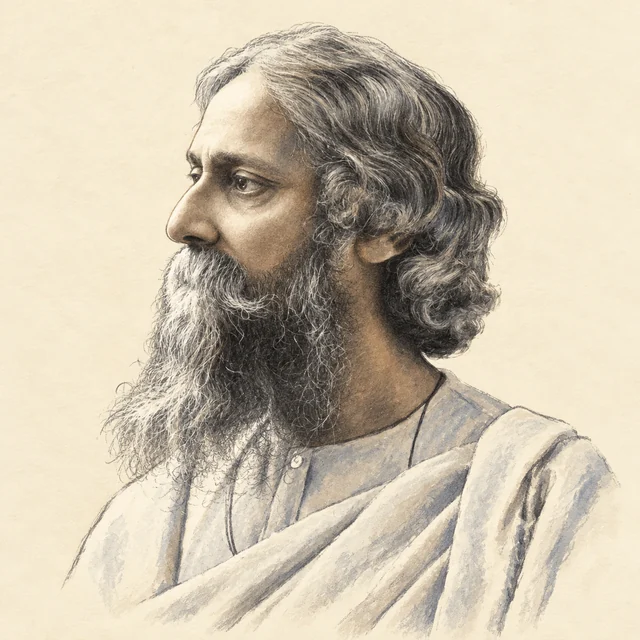
A life in context
The person behind the prize
Rabindranath Tagore grew up in a Bengali family engaged in religious reform, education and the arts. Educated largely at home, he went to England as a young man but did not complete his studies there. Managing family estates later brought him into closer contact with rural lives, which informed fiction and social concerns alongside his poetry. Collections such as Manasi in 1890 and Sonar Tari in 1894 established his literary standing in Bengal. He founded an experimental school at Santiniketan in 1901. In 1912, Gitanjali: Song Offerings appeared in English, using his own prose recastings of poems selected from several Bengali collections. It was not a one-to-one translation of the Bengali Gitanjali published in 1910. The English book, and other writing including The Gardener in 1913, brought a much wider international readership. The 1913 Literature Prize recognised the sensitive and distinctive verse through which he made his poetic thought accessible in English. His work extended to songs, stories, novels, drama, essays and painting. Travel and educational work made him an international public figure, while his relationship with colonial rule and nationalism was more complex than a single label can convey. He received a British knighthood in 1915 and later repudiated the honour. He died in Calcutta in 1941. The sources here provide biographical and publication context, rather than a claim to have read his complete works.
The contribution
Tagore received the full Literature Prize for his verse and the English expression of his poetic thought. His own recastings, especially Gitanjali: Song Offerings, brought a Bengali literary imagination into a new readership without replacing its original language and context.
The idea in plain language
The English Gitanjali: Song Offerings, published in 1912, drew on poems from several Bengali collections. Tagore reshaped them in English prose-poetic form. It was not an exact volume-for-volume translation of the Bengali Gitanjali of 1910. That distinction matters: the English book was a selection and a new act of expression, while the Bengali originals retained their own forms and contexts.
Read the full award story ↗

