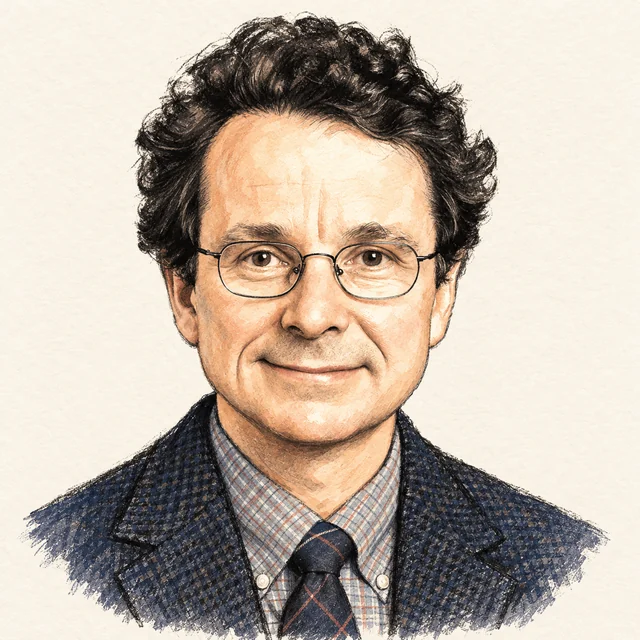
A life in context
The person behind the prize
MacKinnon studied biochemistry at Brandeis University and received a medical degree from Tufts in 1982. After working as a physician, he returned to laboratory research on ion channels. He joined Harvard in 1989 and Rockefeller University in 1996. To understand how a channel distinguishes ions, he undertook the difficult task of learning crystallography and obtaining usable crystals of a membrane protein.
The contribution
In 1998 MacKinnon and his team determined the structure of a bacterial potassium channel. The image revealed a narrow selectivity filter lined by oxygen atoms that can coordinate potassium ions as surrounding water molecules are shed. This helped explain why the channel strongly favours potassium over the smaller sodium ion. Selectivity is an energetic and chemical problem, not simply a sieve that admits anything small enough.
The idea in plain language
A cell membrane separates the inside of a cell from its surroundings. Its fatty interior makes passage difficult for charged ions and limits water movement. Yet cells must exchange water quickly and control ion flow with great precision. Protein channels provide specialised routes through the membrane, allowing rapid transport while discriminating between molecules or ions.
Read the full award story ↗