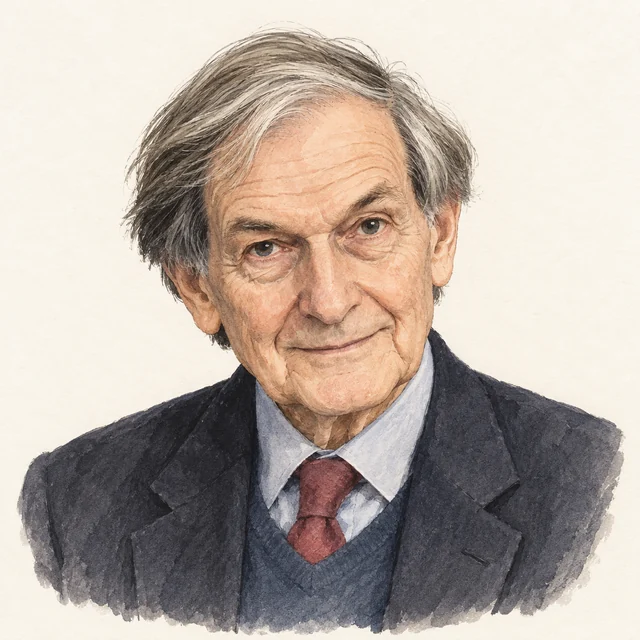
A life in context
The person behind the prize
Penrose earned his doctorate at the University of Cambridge in 1957. He brought geometrical thinking to the question of what happens when gravity becomes extremely strong. At the award he was associated with the University of Oxford. His work showed how mathematics could test whether the strange outcomes of Einstein’s equations depended on unrealistic, perfectly symmetrical assumptions.
The contribution
In 1965, he developed a theorem showing that gravitational collapse can lead to a singularity under specified physical and mathematical conditions. His use of trapped surfaces helped establish black-hole formation as a robust prediction of general relativity.
The idea in plain language
Einstein’s theory describes gravity through the geometry of spacetime. Penrose showed that collapse toward a singularity is not merely an artefact of assuming a perfectly spherical star. Under the theorem’s conditions, a trapped surface marks a situation in which even outward-directed light is forced toward smaller regions.
Read the full award story ↗