A life in context
The person behind the prize
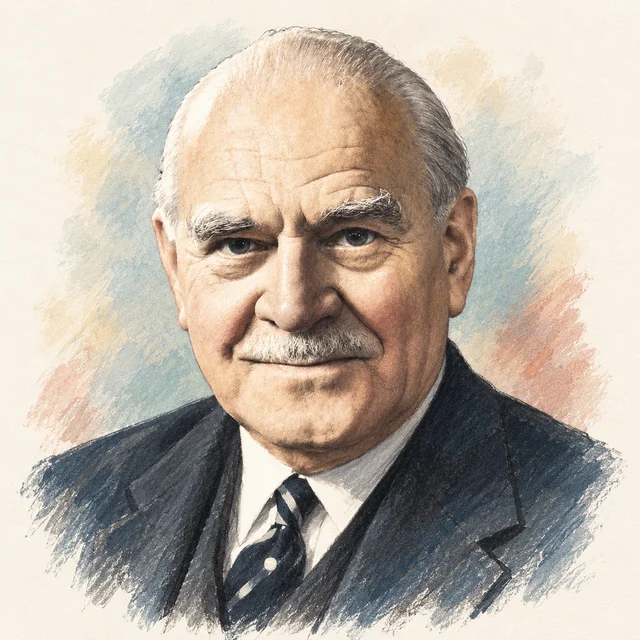
Norrish won a Cambridge entrance scholarship in 1915, but military service interrupted his studies. After wartime captivity he returned in 1919. Eric Rideal encouraged his photochemical research. He became a college fellow and demonstrator in 1925, lecturer in 1930 and professor of physical chemistry in 1937. Work covered photochemistry, combustion, polymerisation and reaction kinetics. After the war, Norrish and his student George Porter developed flash photolysis and kinetic spectroscopy to observe short-lived intermediates. He retired from the chair in 1965 and continued research in Cambridge. Cambridge remained his award-year affiliation; the biography’s 1968 and 1969 honours came later.
The contribution
Norrish, with Porter, developed flash photolysis and kinetic spectroscopy. He received one quarter of the Chemistry Prize.
The idea in plain language
Some chemical transformations happen before ordinary mixing and sampling can reveal their steps. Eigen developed methods that perturb an equilibrium very rapidly, then follow the system’s relaxation. Ultrasound, electrical changes and temperature jumps offered different ways to investigate fast processes.
Read the full award story ↗