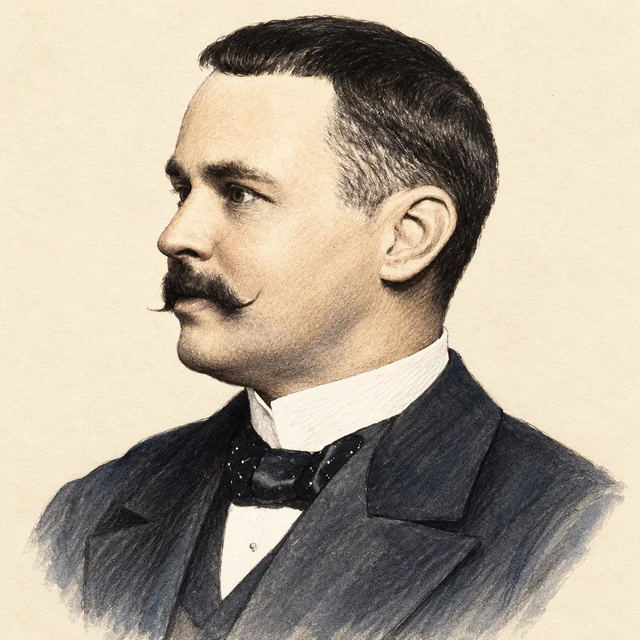
A life in context
The person behind the prize
Ronald Ross was born at Almora in British India and studied medicine at St Bartholomew’s Hospital in London from 1875. He entered the Indian Medical Service in 1881. Questions about malaria drew him into research, and discussions with Patrick Manson encouraged investigation of mosquitoes as a possible link in transmission. Laveran had already identified malaria parasites in human blood; the unresolved problem concerned how the parasite moved between hosts and developed outside the human body. In 1897 Ross found a stage of the human malaria parasite in the wall of a mosquito’s stomach. In 1898 he continued with bird malaria and traced development through the mosquito, including the route that made transmission by a later bite possible. These are related but distinct findings: the bird experiments were not a complete demonstration of every stage of human malaria. Grassi, Bignami and Bastianelli subsequently established further details of human transmission, contributions explicitly acknowledged in the Nobel presentation speech. The work also depended on local assistants and patient participation within a colonial medical system. A Wellcome Collection catalog description names Mohamed Bux as an assistant at the Calcutta laboratory in 1898; recognising such participation gives a fuller account than a lone-discoverer narrative. Ross joined the Liverpool School of Tropical Medicine in 1899 and undertook work in West Africa. In 1902 he became professor of tropical medicine and received the full Physiology or Medicine Prize. Later research connected disease transmission with mathematical models and organised prevention, including work associated with Mauritius and his 1911 book The Prevention of Malaria. He moved to London in 1912 and became director of the Ross Institute in 1926, remaining there until his death in 1932. His research helped make a vector’s role experimentally tractable, but malaria is caused by parasites, not by the mosquito alone, and the historical work should not be confused with a modern treatment protocol or a claim that all mosquitoes transmit the disease.
The contribution
Ross provided key evidence for development of malaria parasites in mosquitoes, with human-malaria observations in 1897 and further transmission work in birds in 1898. His full prize recognised a foundation for subsequent research and prevention, within a wider collaborative history.
The idea in plain language
Following Manson’s encouragement, Ross investigated the mosquito hypothesis. In 1897 he observed a stage of the human malaria parasite in a mosquito’s stomach wall. That finding linked the infected host with development in the insect, beyond an association between mosquitoes and fever.
Read the full award story ↗

