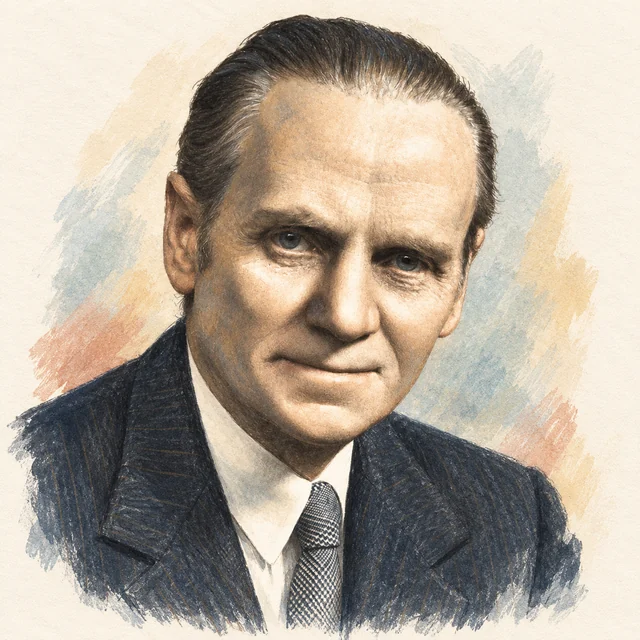
A life in context
The person behind the prize
Born Ralph Norman Angell Lane, Angell worked in several occupations in the United States before building a career in journalism and political writing in Europe. Europe’s Optical Illusion appeared in 1909 and was expanded as The Great Illusion in 1910. He argued that conquest did not straightforwardly enrich the victor in an economically interdependent world. This was a challenge to the claimed benefits of war, not a prediction that people could no longer choose it. He lectured widely, served as a Labour MP from 1929 to 1931 and was knighted in 1931. His work with the League of Nations Union concerned a British advocacy organization, distinct from holding office in the League itself. The 1933 Peace Prize was reserved and awarded to him in 1934. He was absent from the December 1934 ceremony, where British minister Cecil Dormer accepted it. Angell delivered his Nobel lecture on 12 June 1935. His later advocacy of collective security should not be reduced to unconditional non-resistance.
The contribution
Angell received the full Peace Prize for examining the economic claims used to justify war and for promoting international cooperation through public education, especially through The Great Illusion.
The idea in plain language
Governments and publics could treat the seizure of territory as a direct addition to national wealth. Angell asked how that claim worked in societies connected through credit, trade and the labour of living populations. Taking political control did not automatically transfer productive prosperity to the conqueror. Destruction, disrupted exchange and the burdens of domination could undermine the supposed gain. His argument challenged a justification for war, rather than proving that every participant would always act in its economic interest.
Read the full award story ↗

