A life in context
The person behind the prize
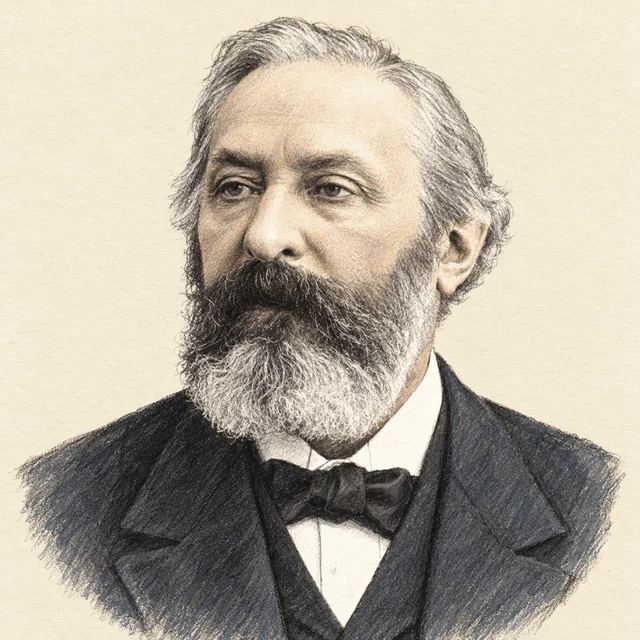
Sully Prudhomme was the pen name of René François Armand Prudhomme, born in Paris in 1839. An early interest in engineering was interrupted by problems with his eyesight. He worked for the Schneider industrial firm at Le Creusot and in a legal office before turning increasingly to literature. The contrast between technical interests and inward feeling remained productive in his writing. His first collection, Stances et Poèmes, appeared in 1865 and attracted attention from Sainte-Beuve. It included Le Vase brisé, a poem that became especially well known, but his literary career cannot be reduced to a single familiar image. He was associated with the Parnassian concern for controlled form and exact language, while exploring private emotion, doubt, conscience and the difficulty of knowing. Collections such as Les Solitudes and Les Vaines Tendresses developed this inward attention. Later works, including La Justice in 1878 and Le Bonheur in 1888, made philosophical questions more explicit. His interests also extended to aesthetics, science and religious thought. He was elected to the Académie française in 1881 and received there the following year. When the Swedish Academy awarded him the whole first Literature Prize in 1901, it faced the problem of comparing different kinds of writing and interpreting Alfred Nobel’s request for an idealistic tendency. Its presentation speech particularly valued Prudhomme’s shorter reflective lyrics, rather than simply preferring his most abstract or didactic poems. That distinction matters: his poetry was not a set of scientific conclusions in verse, and the award was an institutional judgment about literary qualities, not an objective ranking of all writers. Illness prevented him from attending the Stockholm ceremony; the French minister received the prize on his behalf. Prudhomme used prize money to support an award helping an unpublished young poet bring work into print, linking public recognition with opportunities for later writers. He continued writing, including a study of Pascal’s religious thought, and died at Châtenay in 1907. A posthumous collection, Épaves, appeared in 1908. His career offers a way to approach the first Literature Prize through the meeting of formal discipline and inward experience, while leaving room for readers to question the Academy’s preferences and to distinguish literary interpretation from experimental proof.
The contribution
Prudhomme joined carefully shaped lyric poetry with reflection on feeling, knowledge and conscience. The first Literature Prize recognised his body of work, with the presentation speech especially praising his shorter contemplative lyrics.
The idea in plain language
An image or small incident can carry a larger inner experience. Prudhomme’s lyric writing made private feeling a subject for exact verbal form rather than treating reflection and emotion as separate kinds of writing.
Read the full award story ↗

