A life in context
The person behind the prize
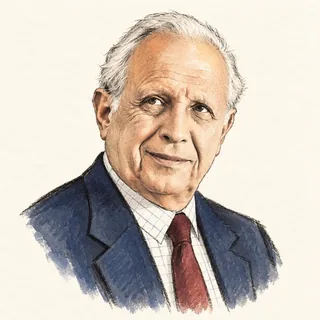
Hänsch received his physics doctorate at Heidelberg in 1969. He became a leading researcher in laser spectroscopy and was affiliated with the Max Planck Institute of Quantum Optics and Ludwig Maximilian University of Munich at the time of the prize. His experiments sought sharper views of atomic transitions, where increasingly precise frequency measurements can test the laws of physics.
The contribution
Hänsch recognised how the evenly spaced frequencies of a short-pulse laser could serve as a ruler for optical frequencies. His group demonstrated the extraordinary regularity of the spacing and developed methods to determine and stabilise the comb’s offset. Work by his group, Hall’s group and collaborators made it possible to connect optical measurements with much slower frequency references.
The idea in plain language
Light behaves as an electromagnetic field, but a detector absorbs its energy in discrete events. Glauber developed a quantum description that connects the state of the light with the statistics of these events. Two beams with the same average brightness can have different correlations: thermal light tends to produce bunching, while an ideal coherent state has different counting statistics.
Read the full award story ↗