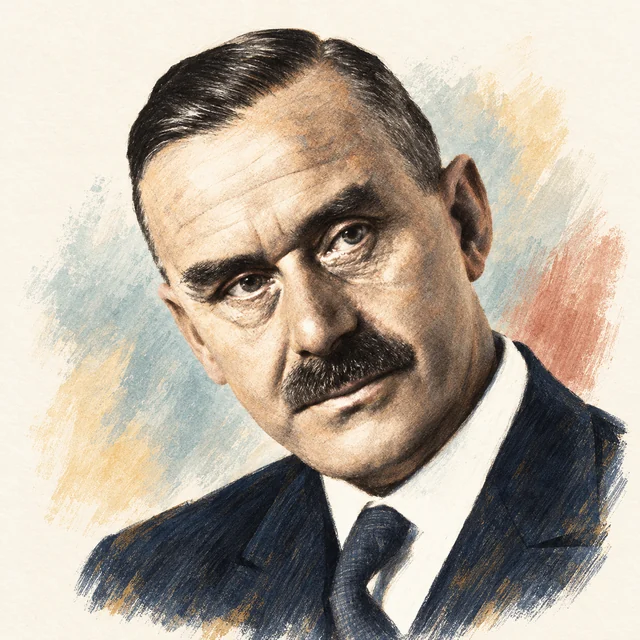
A life in context
The person behind the prize
Mann grew up in a Lübeck merchant family. After his father’s death and the liquidation of the family business, he moved to Munich, worked briefly in insurance and attended lectures while developing as a writer. A first story collection appeared in 1898. Buddenbrooks, published in 1901, followed several generations of a merchant family and brought sustained recognition. Tonio Kröger and other stories explored tensions between artistic reflection and ordinary social belonging. He married Katia Pringsheim in 1905; they had six children. The Magic Mountain appeared in 1924, but the 1929 Nobel citation singled out Buddenbrooks principally. Mann’s political development included wartime conservatism and subsequent revision of his views; he should not be portrayed as holding one unchanged position throughout his life. After the Nazis took power he lived in exile, lost German citizenship in 1936 and became a United States citizen in 1944. His later novels included Joseph and His Brothers and Doctor Faustus. He eventually returned to Europe and died near Zurich in 1955.
The contribution
Mann received the full Literature Prize, principally for Buddenbrooks. The novel combined a detailed merchant-family chronicle with irony and reflection on changing social, artistic and personal values.
The idea in plain language
Published in 1901, Buddenbrooks traces the life and decline of a prosperous merchant family. Business, marriage, habits, speech and music become ways of seeing how individuals inhabit a social world. The family story accumulates its meaning across generations rather than through one decisive discovery or heroic act.
Read the full award story ↗

