A life in context
The person behind the prize
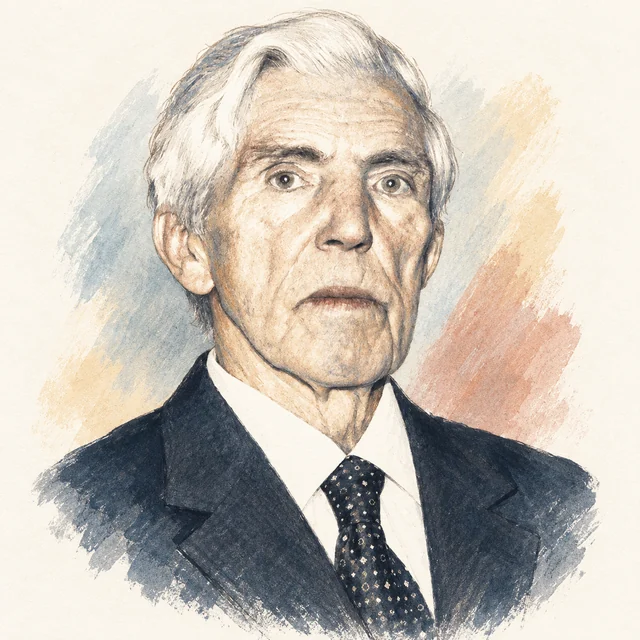
Haavelmo earned his economics degree at Oslo in 1933 and worked as a research assistant with Ragnar Frisch. He lectured in statistics at Aarhus, then spent wartime years in the United States as a fellow, statistician and Norwegian commercial attaché. His probability approach was presented at Harvard in 1941 and published in 1944; Oslo awarded his doctorate in 1946. After work at the Cowles Commission and in Norwegian government, he became an Oslo professor in 1948. Research on development and investment accompanied influential teaching.
The contribution
Haavelmo formulated economic models as probabilistic systems so that data could support estimation and testing. He analysed how mutually dependent relations, such as supply and demand, create identification and estimation problems. Observed price–quantity pairs alone need not reveal either underlying curve. Clear structural assumptions and suitable variation are needed; fitting a line is insufficient. He received the whole Economic Sciences memorial prize for these foundations and analyses.
The idea in plain language
Economic data are produced by many interacting decisions, rather than by one isolated relation. A market’s observed prices and quantities reflect both supply and demand. Simply fitting a curve through those outcomes need not identify either underlying relation. Haavelmo showed why a model must specify the structure generating the observations and what information can distinguish competing explanations.
Read the full award story ↗