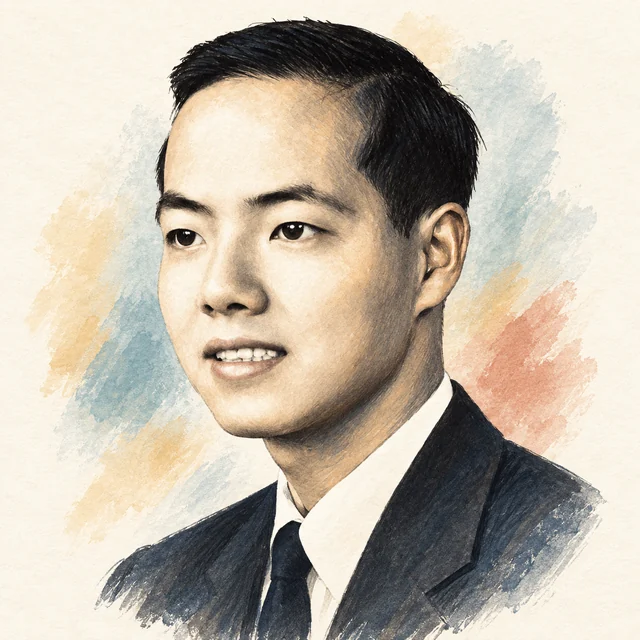
A life in context
The person behind the prize
Lee studied at Zhejiang University in 1943–1944 and at National Southwest Associated University in 1945. A fellowship took him to Chicago in 1946 after undergraduate study; his official biography does not establish a completed bachelor’s degree before that move. He received his doctorate under Fermi in 1950, with research concerning white-dwarf stars. Appointments at Yerkes, Berkeley and the Institute for Advanced Study preceded his arrival at Columbia in 1953. He became associate professor in 1955 and full professor in 1956. Work on particle physics and statistical mechanics included the parity question with Yang. Their 1956 paper distinguished an accepted assumption from experimentally established evidence in weak interactions. Its proposed tests helped prompt the experiments that overturned parity conservation in that domain. Lee received half of the 1957 prize while affiliated with Columbia. The award recognised the theoretical investigation, while Wu and her experimental collaborators deserve explicit credit for testing it.
The contribution
Lee and Yang exposed the untested parity assumption in weak interactions and formulated experimental tests. Lee received one half of the Physics Prize.
The idea in plain language
Physicists widely assumed that reflecting the spatial arrangement of a process would leave the underlying laws unchanged. This parity symmetry was well supported in other domains, but Lee and Yang’s 1956 review found no decisive evidence establishing it for weak interactions, such as beta decay. An accepted assumption needed a specific experimental test.
Read the full award story ↗