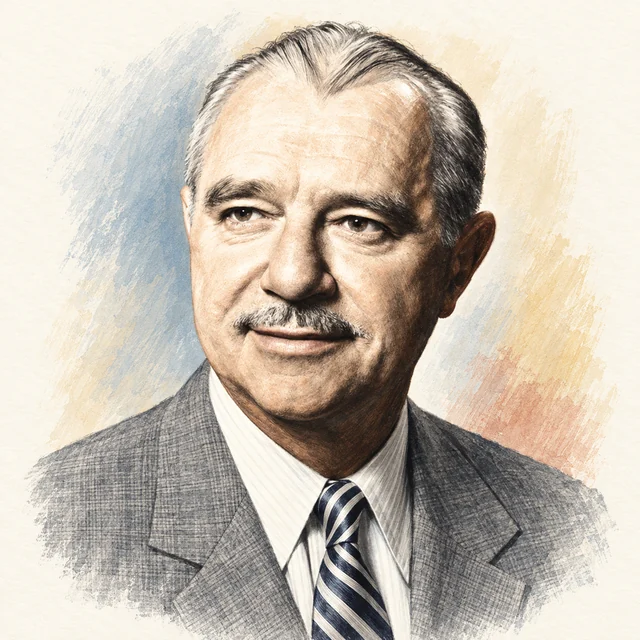
A life in context
The person behind the prize
Du Vigneaud studied chemistry at Illinois, earning bachelor’s and master’s degrees in 1923 and 1924. Work in Philadelphia preceded his Rochester doctorate in 1927 under John Murlin, with research on insulin. Postdoctoral work at Johns Hopkins, Edinburgh and London broadened his biochemical training. After returning to Illinois, he became head of biochemistry at George Washington’s medical school in 1932 and at Cornell University Medical College in 1938. His programme followed sulfur-containing biological compounds through insulin, amino-acid metabolism and peptide hormones. His group purified oxytocin in 1949 and reported synthesis in 1953, with a fuller paper in 1954. Collaborators included Charlotte Ressler, John M. Swan, Carleton W. Roberts, Panayotis G. Katsoyannis and Samuel Gordon. He received the full 1955 prize while working at the medical college in New York. The official facts page’s Ithaca location should be distinguished from his later move there in 1967. His doctoral training was in biochemistry.
The contribution
Du Vigneaud investigated biologically important sulfur compounds and led the first synthesis of a peptide hormone, oxytocin. He received the full Chemistry Prize.
The idea in plain language
Could a biologically active peptide be understood well enough to make it? Du Vigneaud investigated sulfur-containing biological compounds, including amino acids, insulin-related questions and peptide hormones. His group purified oxytocin in 1949. Establishing its composition and connections prepared the way for synthesis.
Read the full award story ↗

