A life in context
The person behind the prize
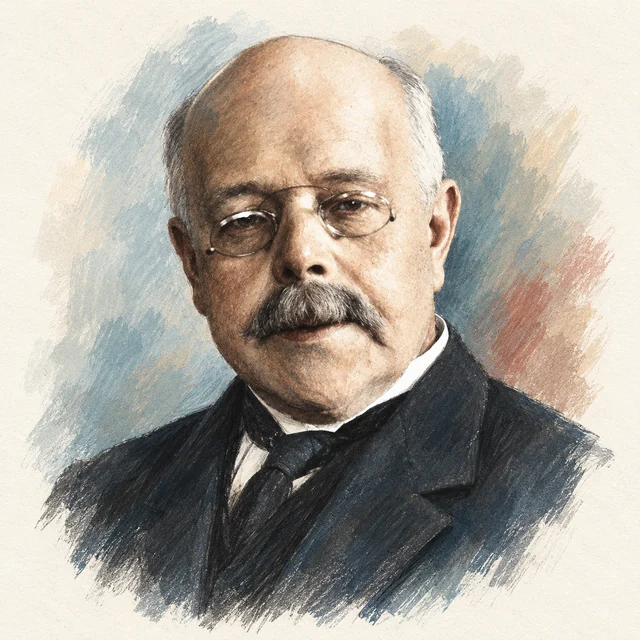
Nernst studied physics and mathematics at several European universities and completed a doctorate at Würzburg in 1887. Work with Wilhelm Ostwald in Leipzig drew him towards physical chemistry and electrochemistry. He later led an institute in Göttingen before moving to Berlin in 1905. A central problem was how to calculate the driving force and equilibrium of a chemical reaction from thermal measurements. Heat released in a reaction and the useful work it can supply are related, but they are not generally the same quantity. Nernst developed his heat theorem in 1906, using limiting behaviour at very low temperatures to constrain thermodynamic calculations. With his collaborators he measured heat capacities and chemical equilibria, connecting theoretical reasoning with demanding experiments. The work became associated with the third law of thermodynamics. The 1920 Chemistry Prize was reserved and awarded to him in 1921; Berlin University was his official affiliation. His wider interests included electrochemistry, photochemistry and practical inventions, but the prize recognised thermochemistry. He retired in 1933 and died in 1941. The theorem concerns equilibrium and thermodynamic limits, not a guarantee that a proposed industrial reaction will run quickly or be easy to build.
The contribution
Nernst received the full Chemistry Prize for thermochemical work. His heat theorem and low-temperature measurements helped connect heat data with chemical driving forces, maximum useful work and equilibrium conditions.
The idea in plain language
Measuring a reaction’s heat does not by itself tell us how much useful work can be obtained or what equilibrium mixture will result. Temperature matters, and heat capacities describe how substances store thermal energy as temperature changes. Thermochemistry needed a way to connect these measurements with chemical driving forces.
Read the full award story ↗

