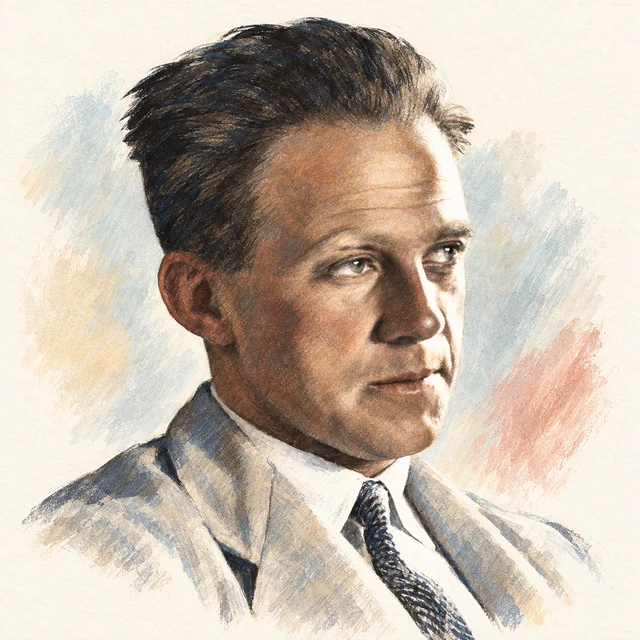
A life in context
The person behind the prize
Heisenberg studied physics in Munich with Arnold Sommerfeld and completed his doctorate in 1923. Work with Max Born in Göttingen and Niels Bohr in Copenhagen brought him into the effort to replace the old quantum theory. In 1925 he developed a new approach based on relations between observable atomic transitions rather than imagined electron orbits. Born and Pascual Jordan helped give this approach its matrix formulation. Heisenberg’s uncertainty relation followed in 1927, the year he became professor in Leipzig. The 1932 Physics Prize was reserved and then awarded to him in 1933; Schrödinger and Dirac received their separate 1933 prize at the same ceremony. His later career included a leading role in Nazi Germany’s uranium research and the directorship of the Kaiser Wilhelm Institute for Physics from 1942. Scientific distinction does not settle the moral and historical questions surrounding that work. After the war he led the re-established institute in Göttingen and its later move to Munich.
The contribution
Heisenberg received the full 1932 Physics Prize, awarded in 1933, for creating quantum mechanics and its applications. His 1925 approach helped replace classical electron trajectories with a calculational framework for atomic transitions.
The idea in plain language
The old quantum theory mixed classical electron orbits with special rules for allowed energies. It worked in some cases but struggled with more complicated atoms. Heisenberg changed the starting point: rather than draw an unobserved trajectory, relate the frequencies and strengths of transitions that appear in atomic spectra. The resulting quantities could be arranged in arrays. Born and Jordan helped develop the matrix mathematics, in which the order of multiplication matters.
Read the full award story ↗

