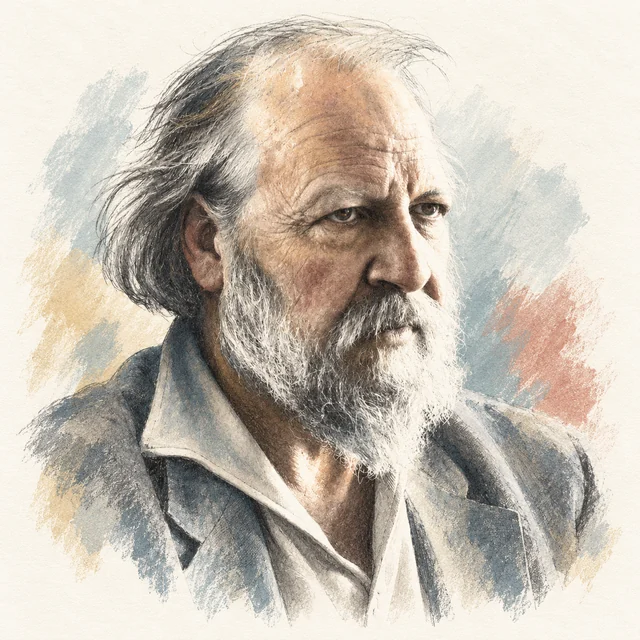
A life in context
The person behind the prize
Golding grew up in Marlborough and entered Brasenose College, Oxford, in 1930. After two years of science he changed to English, graduating in 1934; his poetry collection Poems appeared that year. Teaching at Bishop Wordsworth’s School in Salisbury was interrupted by Royal Navy service during the Second World War, including the Normandy landings. He returned to teaching after the war and later became a full-time writer. Lord of the Flies appeared in 1954. The Inheritors, The Spire and Darkness Visible explored different worlds and forms of moral conflict. Rites of Passage won the 1980 Booker Prize. His wife Ann was an important critic and supporter.
The contribution
Golding joined concrete, realistic storytelling to the reach of myth. His novels examine power, fear, self-deception and responsibility through contrasting viewpoints and unsettled interpretations. The Literature Prize recognised this body of fiction, not only Lord of the Flies. Invented characters and situations are literary ways to question human conduct, not controlled psychological experiments or proof that everyone is inevitably cruel.
The idea in plain language
In Lord of the Flies, schoolboys stranded on an island struggle with authority, fear and violence. The novel unsettles easy confidence that order and civilisation automatically protect people from cruelty. The Inheritors shifts perspective toward a Neanderthal group encountering another human population, making the reader’s own assumptions part of the encounter.
Read the full award story ↗

