01 · The discovery
The idea, in everyday language
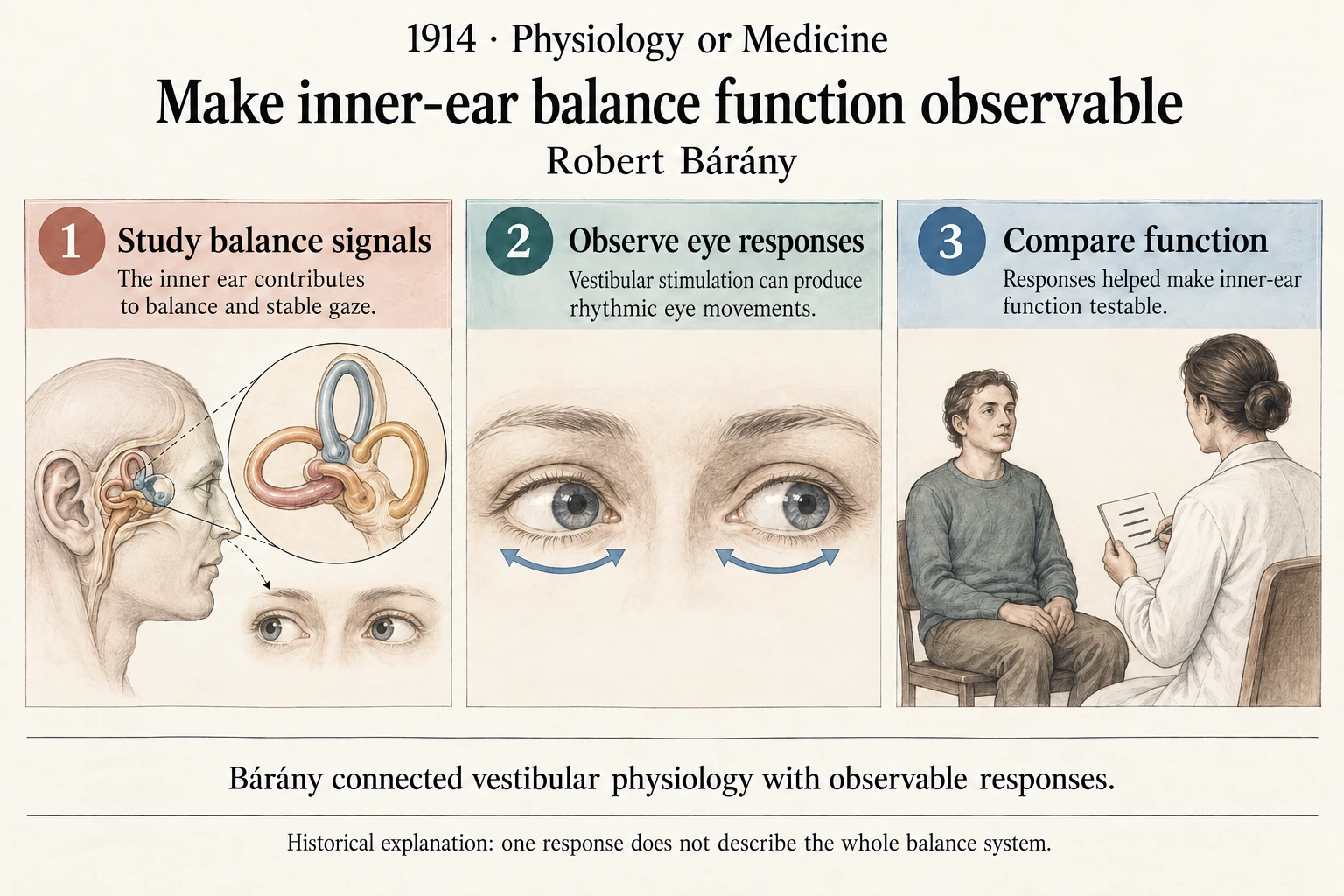
Balance depends on the inner ear working with vision and signals from the body. The vestibular apparatus includes semicircular canals involved in sensing head rotation. Earlier researchers had already connected the inner ear with movement and balance. Bárány’s contribution was to investigate reactions systematically and develop ways to use them in physiological and clinical examination.
He studied rhythmic eye movements, called nystagmus, associated with stimulation of the vestibular system. Temperature-related observations during ear treatment led to the caloric reaction, reported in 1905; he also studied rotation and movement responses. These offered observable evidence about aspects of vestibular function. His 1914 prize was reserved and announced on 29 October 1915. Held as a prisoner of war at the time, he accepted it after his release in 1916.
Why it matters
The work helped connect laboratory physiology and examination of inner-ear disorders. It made particular functions more testable without making any single reaction a complete description of balance, or a universal explanation for dizziness.