01 · The discovery
The idea, in everyday language
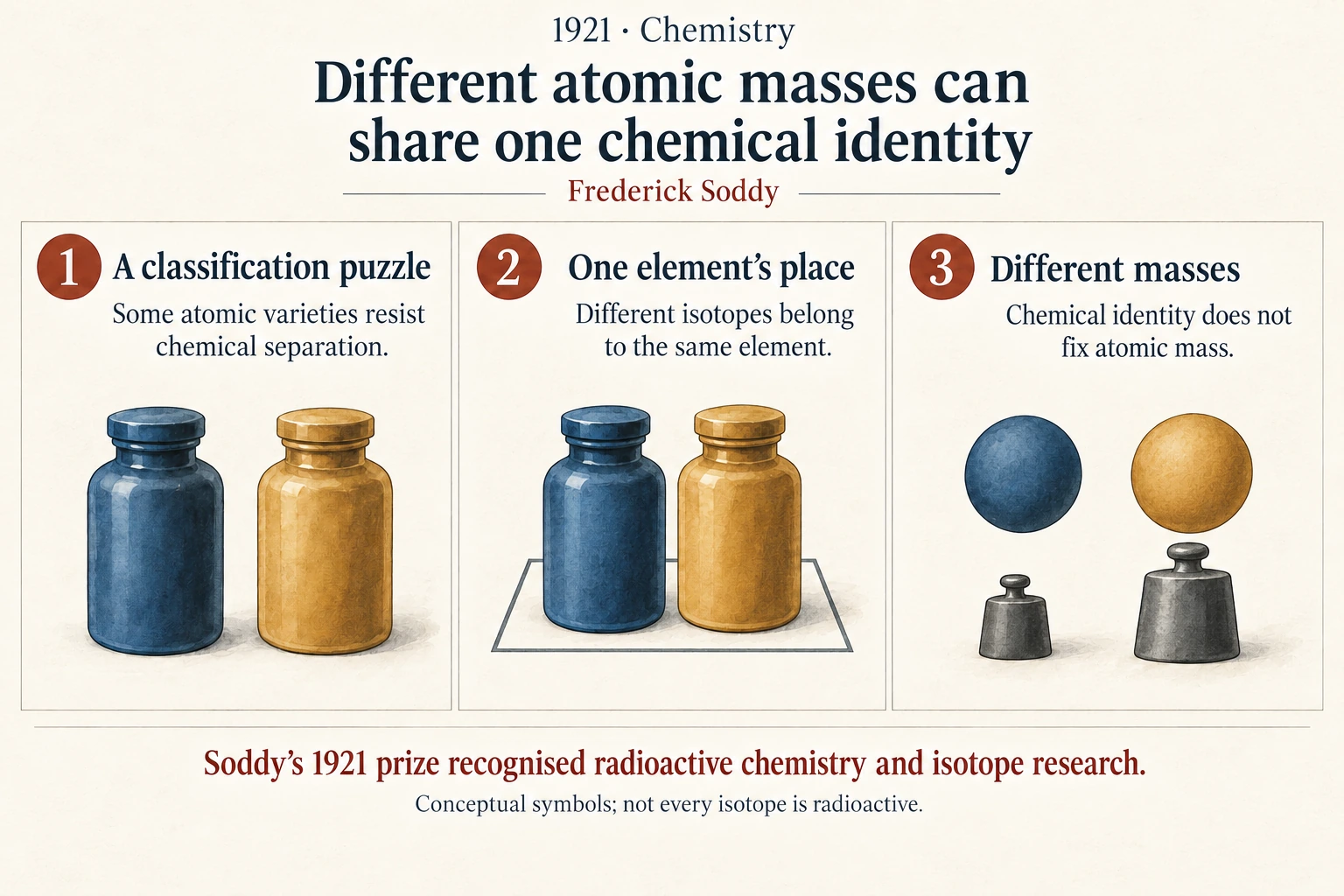
Radioactivity produced a confusing collection of substances. Some behaved differently in radioactive changes but could not be separated by ordinary chemical methods. Treating every radioactive preparation as a new chemical element made the periodic table harder to understand.
Soddy helped show that different atomic varieties could belong to the same element, introducing the term isotope in 1913. In modern terms, isotopes have the same proton number and different neutron numbers, so their masses differ. His work with radioactive change also helped relate transformations to changes of position in the periodic table. The 1921 award recognised radioactive-substance chemistry and isotope investigations; it was reserved, announced on 9 November 1922 and presented that December.
Why it matters
Isotopes reconciled chemical identity with differences in atomic mass and radioactive behaviour. This changed how chemists organised radioactive substances and interpreted elements. Aston’s mass spectrograph supplied a distinct experimental approach, recognised by the 1922 Chemistry Prize; Soddy did not invent that instrument.