01 · The discovery
The idea, in everyday language
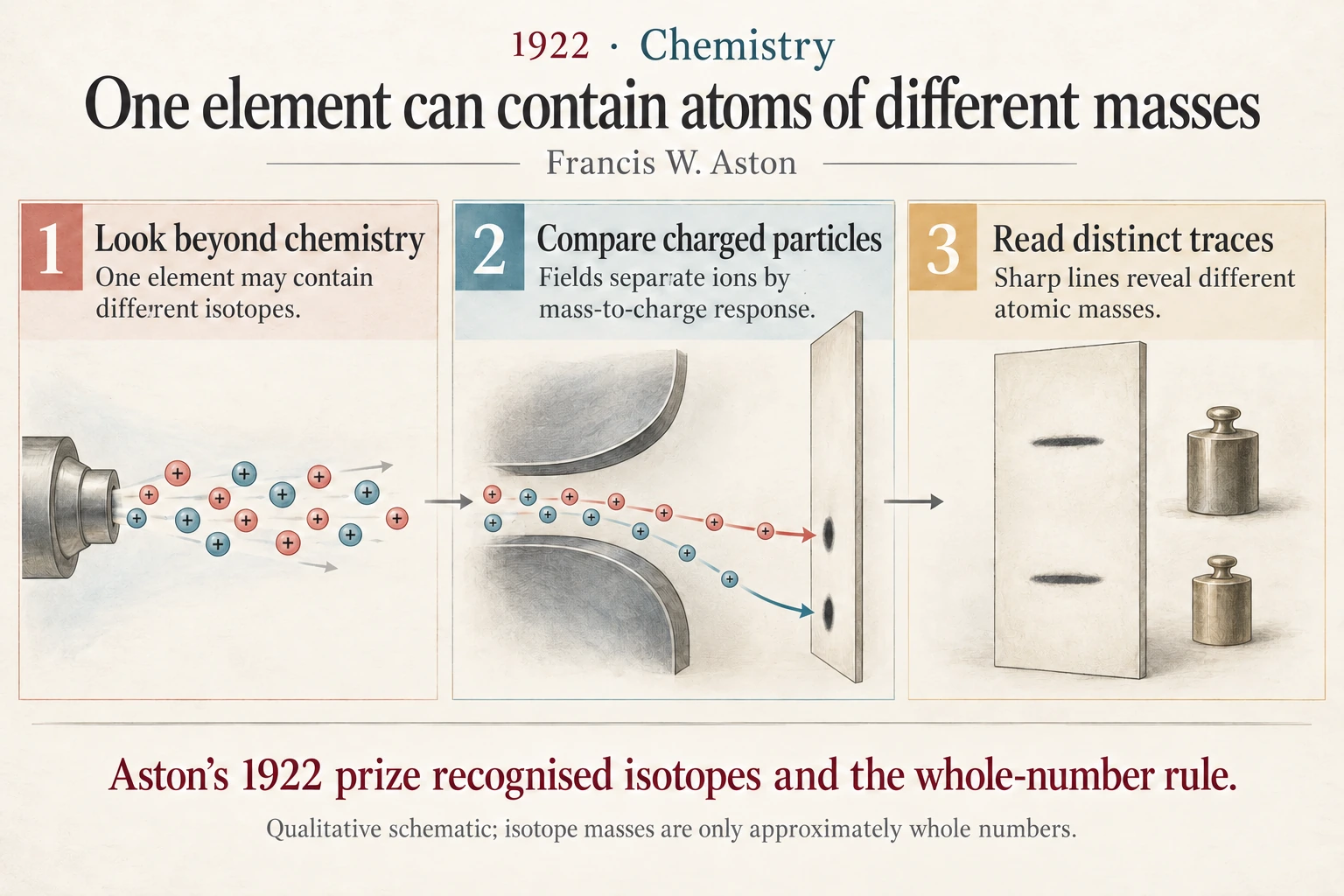
Chemical behaviour alone could hide a difference between atoms of the same element. Earlier work had revealed isotopy, but identifying it widely among non-radioactive elements required a sensitive physical comparison of atomic masses. Aston improved the use of electric and magnetic fields to focus charged particles with the same mass-to-charge ratio into sharp recorded lines.
The separated traces showed that many familiar elements contained more than one isotope. An element’s measured atomic weight could therefore reflect a mixture, rather than one identical mass for every atom. The isotope masses themselves lay close to whole-number values on a suitable scale. Aston’s whole-number rule captured that important pattern; increasing precision also revealed small deviations that could not simply be wished away.
Why it matters
The work made isotope composition experimentally accessible across many elements and changed how chemists understood atomic weights. It linked the apparent fractions in a mixture with distinct constituent masses, helping connect chemical measurements and atomic structure.