c.curionodeThe Nobel Archive

1963 · Peace

Complementary work across a humanitarian movement

The ICRC and the League shared the centenary-year prize for distinct but connected humanitarian responsibilities.

Humanitarian protectionCooperation among national societiesConflict and disaster relief
1963Peace

Visual guide

The prize, pictured

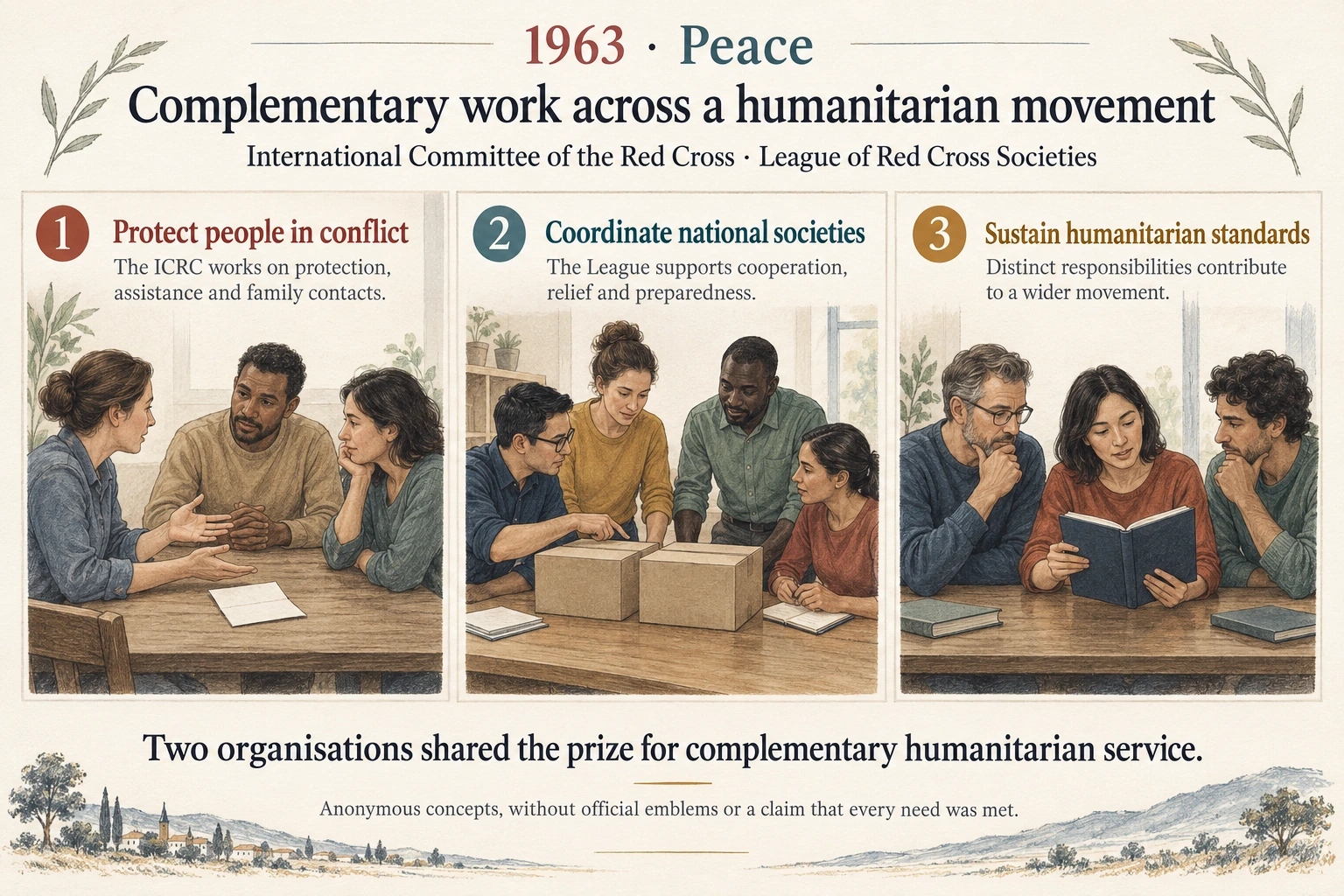
Infographic explaining Complementary work across a humanitarian movement
Original AI-generated infographic. A conceptual overview; the explanations and sources below provide context.
Read the poster text

Two organisations shared the prize for complementary humanitarian service.

  1. Protect people in conflict

    The ICRC works on protection, assistance and family contacts.

  2. Coordinate national societies

    The League supports cooperation, relief and preparedness.

  3. Sustain humanitarian standards

    Distinct responsibilities contribute to a wider movement.

Anonymous concepts, without official emblems or a claim that every need was met.

01 · The contribution

The idea, in everyday language

War and disasters create needs that exceed any one organisation’s capacity. Protecting people affected by armed conflict and coordinating national societies’ relief work require different forms of humanitarian organisation.

The Geneva-based International Committee of the Red Cross worked on conflict-related protection, assistance and family contacts. The League of Red Cross Societies, founded in Paris in 1919, supported cooperation among national societies, relief and preparedness. The wider movement also included the national societies themselves. The 1963 prize recognised the two organisations, not their leaders or award representatives.

Why it matters

Each organisation received one half in the movement’s centenary year. The ICRC had also received prizes in 1917 and 1944. The four Geneva Conventions of 1949 provided an important legal framework for protecting people in armed conflict. The award recognised sustained humanitarian service, rather than proof that wars had ended.

02 · The recipients

Who brought the idea to life?

03 · Years in the making

The path here

  1. 1863

    The committee that became the ICRC is founded in Geneva.

  2. 1917

    The ICRC receives its first Peace Prize.

  3. 1919

    The League is founded in Paris.

  4. 1944

    The ICRC receives another Peace Prize.

  5. 1949

    Four Geneva Conventions are adopted.

  6. 1963

    The ICRC and the League share the centenary-year prize.

04 · Read further

From the original sources

Original explanations by Curionode, based on the official records below. Biographical details and affiliations refer to the award year.

  1. Official award summary nobelprize.org
  2. Award ceremony speech nobelprize.org
  3. Official history: International Committee of the Red Cross nobelprize.org
  4. Official history: League of Red Cross Societies nobelprize.org