01 · The discovery
The idea, in everyday language
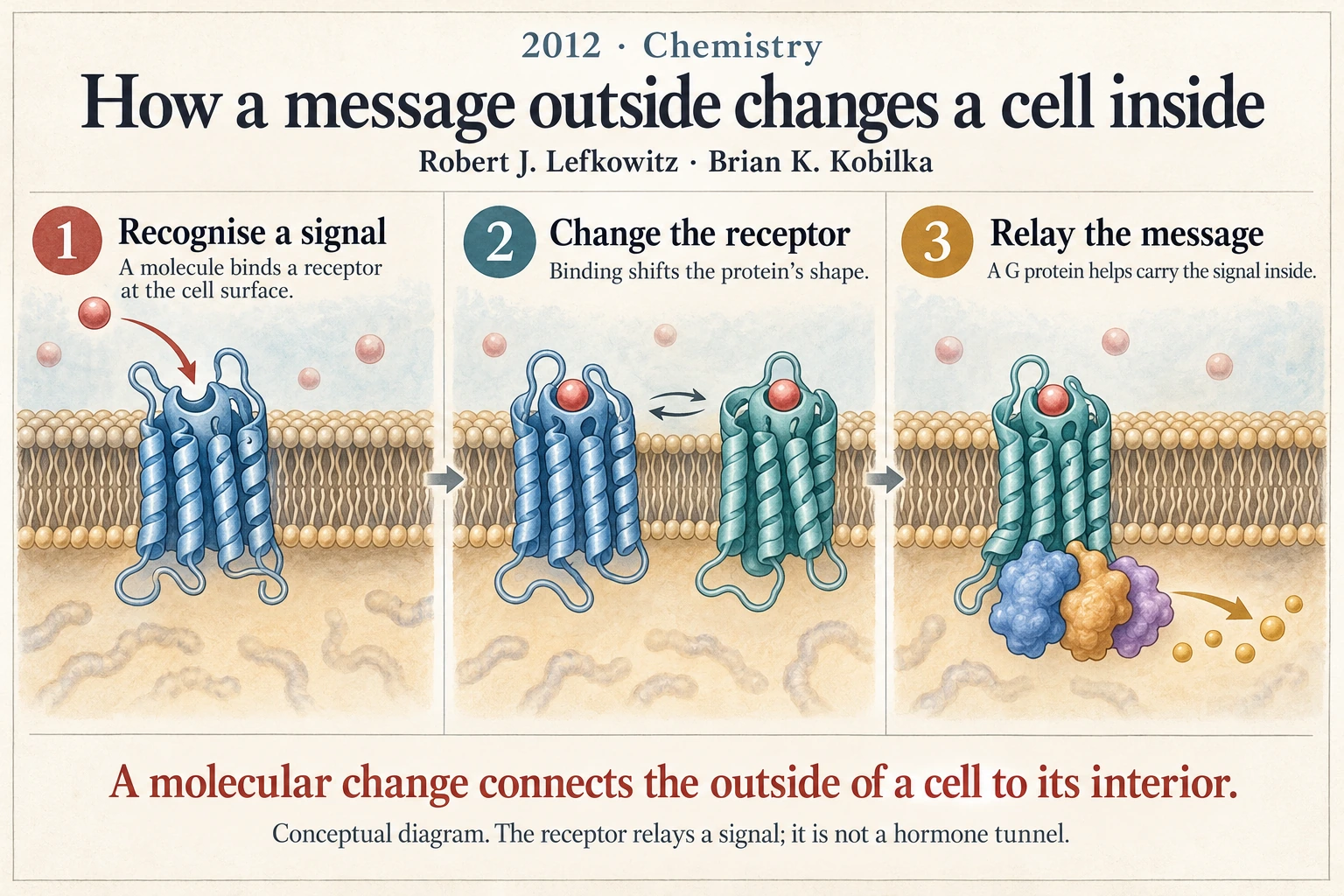
A hormone can change a cell’s behaviour without itself travelling through the cell membrane. A receptor binds the signal and communicates across that boundary. Lefkowitz used labelled substances and biochemical experiments to identify and characterise receptors that had previously been difficult to isolate. His work on beta-adrenergic receptors helped explain how signals such as adrenaline produce a response through specific molecular machinery.
Kobilka helped identify the receptor’s gene, revealing a protein that crosses the membrane seven times and belongs to a much larger family. Determining its three-dimensional structure was especially difficult because the receptor is flexible and embedded in a membrane. In 2011 his team resolved an activated beta-adrenergic receptor coupled to a G protein. The structure helped explain how binding on one side changes the receptor’s shape and enables signalling on the other.
Why it matters
G-protein-coupled receptors help cells respond to hormones, neurotransmitters, odours and light. Understanding how they recognise signals and activate partners provides a molecular foundation for studying disease and designing medicines. A drug may activate a receptor, block it or alter its behaviour; knowing its structure helps researchers ask more precise questions about these effects.