c.curionodeThe Nobel Archive

2012 · Chemistry

How a message outside changes a cell inside

Lefkowitz and Kobilka revealed the molecular workings of G-protein-coupled receptors.

cell signallingGPCRsmolecular structure
2012Chemistry

Visual guide

The prize, pictured

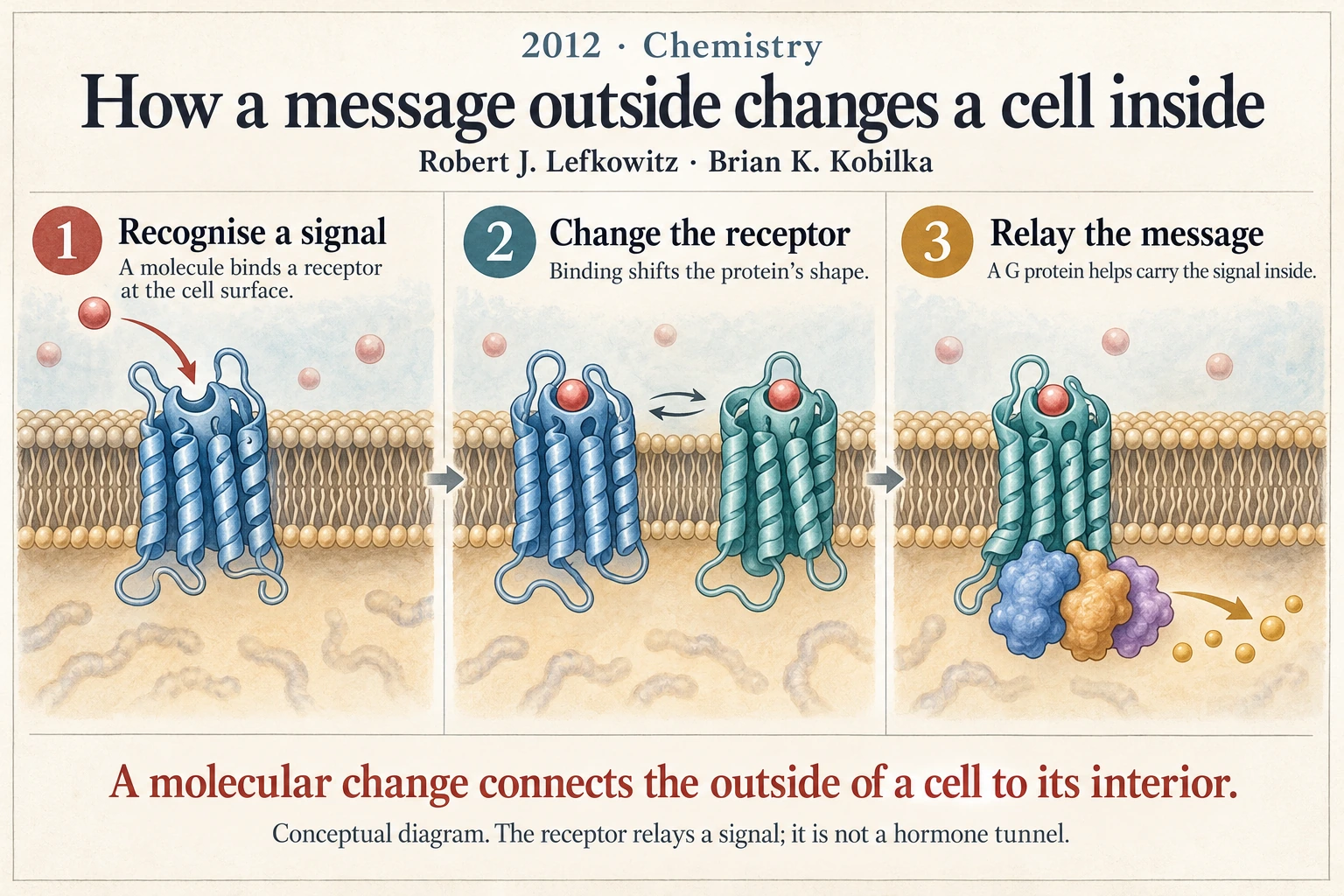
Infographic explaining How a message outside changes a cell inside
Original AI-generated infographic. A conceptual overview; the explanations and sources below provide context.
Read the poster text

A molecular change connects the outside of a cell to its interior.

  1. Recognise a signal

    A molecule binds a receptor at the cell surface.

  2. Change the receptor

    Binding shifts the protein’s shape.

  3. Relay the message

    A G protein helps carry the signal inside.

Conceptual diagram. The receptor relays a signal; it is not a hormone tunnel.

01 · The discovery

The idea, in everyday language

A hormone can change a cell’s behaviour without itself travelling through the cell membrane. A receptor binds the signal and communicates across that boundary. Lefkowitz used labelled substances and biochemical experiments to identify and characterise receptors that had previously been difficult to isolate. His work on beta-adrenergic receptors helped explain how signals such as adrenaline produce a response through specific molecular machinery.

Kobilka helped identify the receptor’s gene, revealing a protein that crosses the membrane seven times and belongs to a much larger family. Determining its three-dimensional structure was especially difficult because the receptor is flexible and embedded in a membrane. In 2011 his team resolved an activated beta-adrenergic receptor coupled to a G protein. The structure helped explain how binding on one side changes the receptor’s shape and enables signalling on the other.

Why it matters

G-protein-coupled receptors help cells respond to hormones, neurotransmitters, odours and light. Understanding how they recognise signals and activate partners provides a molecular foundation for studying disease and designing medicines. A drug may activate a receptor, block it or alter its behaviour; knowing its structure helps researchers ask more precise questions about these effects.


02 · The people

Who brought the idea to life?

Illustrated portrait of Robert J. Lefkowitz

Robert J. Lefkowitz

Prize share · 1/2

Lefkowitz established experimental ways to identify and characterise hormone receptors, including beta-adrenergic receptors. His team connected binding at the outside of a cell with responses inside it, purified receptors and investigated their regulation. This work helped turn a receptor from a hypothetical explanation of a drug’s effect into a molecular object that could be examined.

Read the biography ↗
Illustrated portrait of Brian K. Kobilka

Brian K. Kobilka

Prize share · 1/2

Kobilka helped identify the gene encoding the beta-adrenergic receptor, revealing a seven-helix structure related to the light receptor rhodopsin. Later, his team overcame major obstacles to determining receptor structures. In 2011 they described an activated beta-adrenergic receptor bound to a G protein, showing how a change at the outside could be connected to signalling inside the cell.

Read the biography ↗

03 · Years in the making

The path here

  1. 1970

    Lefkowitz publishes early studies identifying functional hormone-binding sites.

  2. 2011

    Kobilka’s team resolves an activated beta-adrenergic receptor bound to a G protein.

  3. 2012

    The prize recognises studies of G-protein-coupled receptors.

04 · Read further

From the original sources

Original explanations by Curionode, based on the official records below. Biographical details and affiliations refer to the award year.

  1. Official award announcement nobelprize.org
  2. Nobel Committee’s accessible background nobelprize.org

More in Chemistry

Browse this subject ↗