c.curionodeThe Nobel Archive

2024 · Economic Sciences

Why the rules of a society matter

Institutions help explain why some countries prosper while others remain poor.

The Sveriges Riksbank Prize in Economic Sciences in Memory of Alfred Nobel.

InstitutionsPowerProsperity
2024Economic Sciences

Visual guide

The prize, pictured

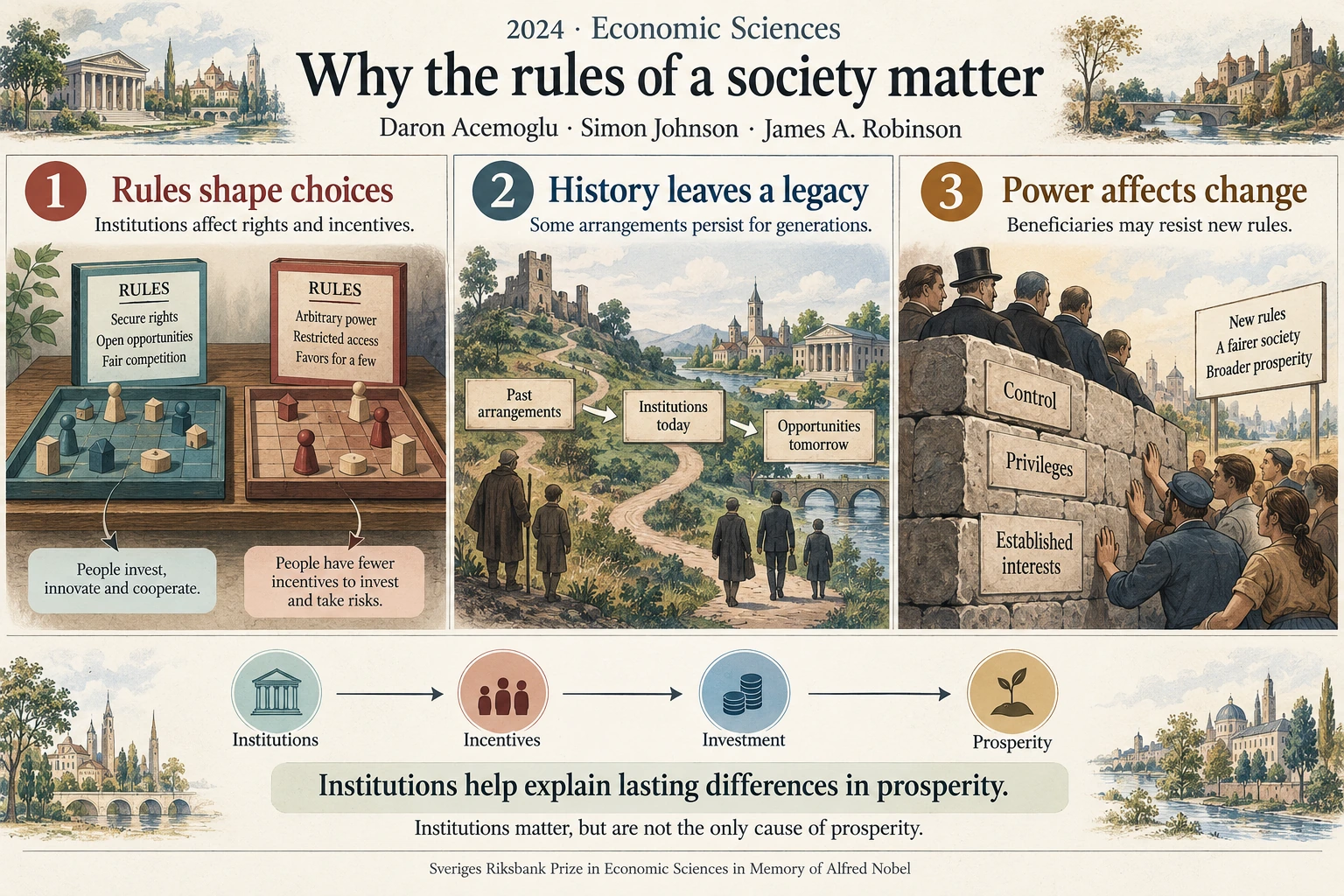
Infographic explaining Why the rules of a society matter
Original AI-generated infographic. A conceptual overview; the explanations and sources below provide context.
Read the poster text

Institutions help explain lasting differences in prosperity.

  1. Rules shape choices

    Institutions affect rights and incentives.

  2. History leaves a legacy

    Some arrangements persist for generations.

  3. Power affects change

    Beneficiaries may resist new rules.

Institutions matter, but are not the only cause of prosperity.

01 · The discovery

The idea, in everyday language

Institutions are the rules and organisations that shape social life: courts, property rights, political representation and limits on power. They influence whether people can invest, cooperate and expect to keep the results of their work.

The laureates used historical evidence and theory to study how different institutions emerged and persisted. Colonial experiences provided important comparisons. Their work also explains why powerful groups may defend arrangements that benefit themselves while limiting wider prosperity.

Why it matters

The research made political power and institutional history central to debates about development, alongside resources, geography and technology.


02 · The people

Who brought the idea to life?

Illustrated portrait of Daron Acemoglu

Daron Acemoglu

Prize share · 1/3

He helped develop evidence and models explaining how institutions shape investment and opportunity, and why groups that benefit from existing rules may resist changes that could improve general prosperity.

Read the biography ↗
Illustrated portrait of Simon Johnson

Simon Johnson

Prize share · 1/3

He contributed to research using colonial history to examine the long-run effects of institutions. The challenge was to distinguish the influence of rules from the possibility that prosperity itself changes those rules.

Read the biography ↗
Illustrated portrait of James A. Robinson

James A. Robinson

Prize share · 1/3

Working with Acemoglu and Johnson, he helped explain why institutions can persist even when they hold back development. Political conflict and the difficulty of making credible promises are central to this account.

Read the biography ↗

03 · Years in the making

The path here

  1. Colonial era

    Different systems of political and economic control are established.

  2. 2001–2002

    Influential studies link historical institutions with later prosperity.

  3. 2024

    The three collaborators share the Economic Sciences prize.

04 · Read further

From the original sources

Original explanations by Curionode, based on the official records below. Biographical details and affiliations refer to the award year.

  1. Official award announcement nobelprize.org
  2. Nobel Committee’s accessible background nobelprize.org

More in Economic Sciences

Browse this subject ↗