c.curionodeThe Nobel Archive

2026 · Economic Sciences

How expectations shape the economy

Robert E. Hall and Michael Woodford built foundations for understanding how households, firms and policy respond to economic shocks.

The Sveriges Riksbank Prize in Economic Sciences in Memory of Alfred Nobel.

ExpectationsConsumptionMonetary policy
2026Economic Sciences

Visual guide

The prize, pictured

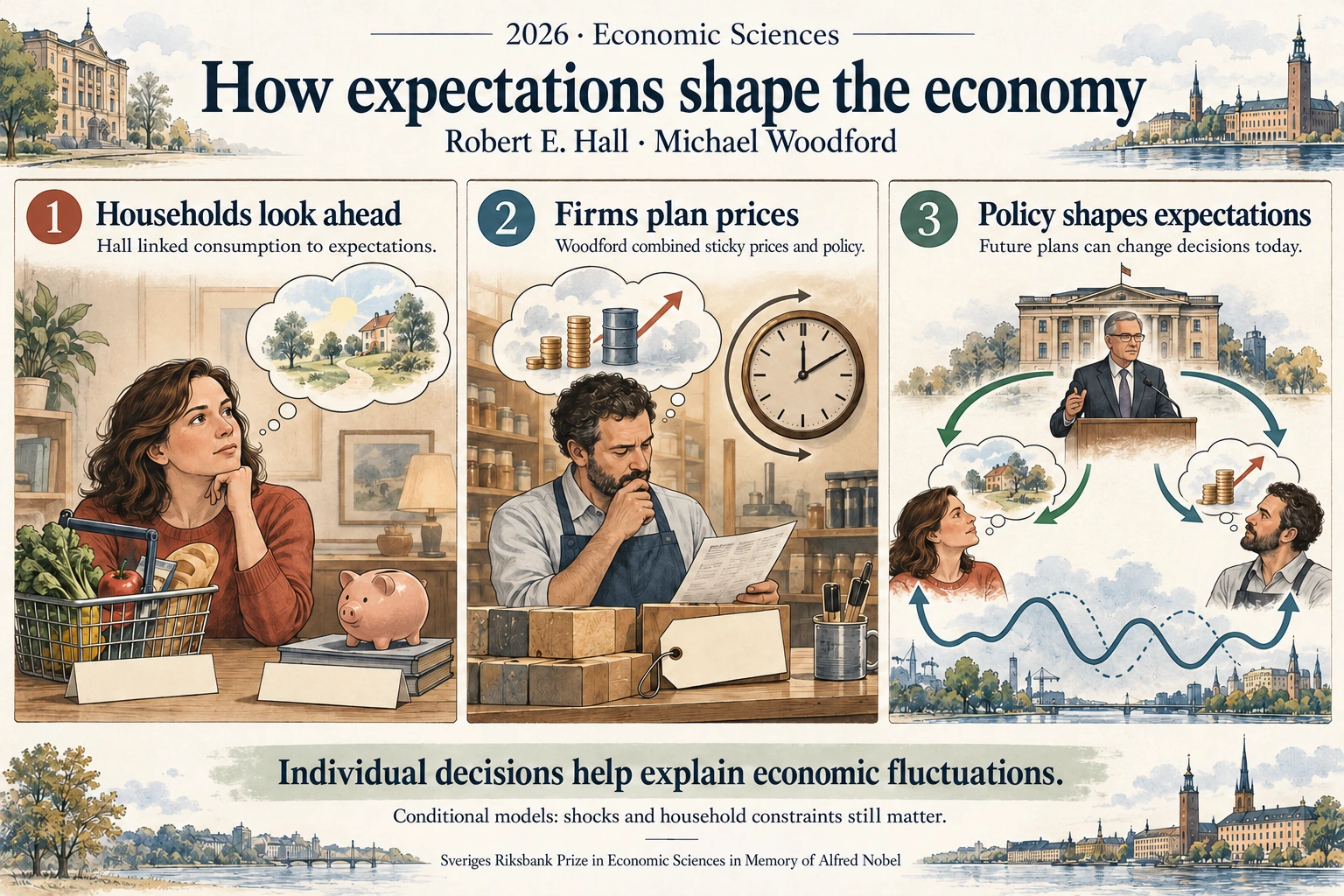
Infographic explaining How expectations shape the economy
Original AI-generated infographic. A conceptual overview; the explanations and sources below provide context.
Read the poster text

Individual decisions help explain economic fluctuations.

  1. Households look ahead

    Hall linked consumption to expectations.

  2. Firms plan prices

    Woodford combined sticky prices and policy.

  3. Policy shapes expectations

    Future plans can change decisions today.

Conditional models: shocks and household constraints still matter.

01 · The discovery

The idea, in everyday language

How can governments and central banks soften recessions and inflation without relying on relationships that break down when policy changes? The laureates helped build macroeconomic models from the decisions of individual households and firms, including their expectations of the future.

Hall turned a theory of forward-looking consumption into a test: under its assumptions, spending changes should be driven by new information. Departures from that benchmark help reveal limits on households’ ability to smooth consumption. Woodford combined forward-looking spending with sticky prices and interest-rate policy in a coherent New Keynesian framework. Credible policy plans can therefore affect decisions before a future rate change takes place.

Why it matters

Their work underpins models used to compare monetary and fiscal policies and assess economic shocks. It helps policymakers examine how spending, prices and expectations interact, rather than assuming that a past statistical relationship will always hold.

02 · The people

Who brought the idea to life?

Illustrated portrait of Robert E. Hall

Robert E. Hall

Prize share · 1/2

His 1978 analysis showed that, under a specific forward-looking consumption model, changes in consumption should reflect new information rather than predictable changes in income. This provided a benchmark for testing expectations and identifying households constrained by limited savings or borrowing.

Read the biography ↗
Illustrated portrait of Michael Woodford

Michael Woodford

Prize share · 1/2

He developed a New Keynesian framework combining forward-looking spending, firms that cannot adjust every price immediately, and interest-rate policy. It explains why expectations about future policy, as well as today’s rate, affect inflation and economic activity.

Read the biography ↗

03 · Years in the making

The path here

  1. 1978

    Hall publishes his forward-looking consumption benchmark.

  2. 1982

    Hall and Fredric Mishkin use household data to examine consumption and liquidity constraints.

  3. 2003

    Woodford publishes Interest and Prices.

  4. 12 October 2026

    The prize is announced, with one half awarded to each laureate.

04 · Read further

From the original sources

Original explanations by Curionode, based on the official records below. Biographical details and affiliations refer to the award year.

  1. Official award announcement nobelprize.org
  2. Royal Swedish Academy announcement kva.se
  3. Nobel Committee’s accessible background nobelprize.org

More in Economic Sciences

Browse this subject ↗