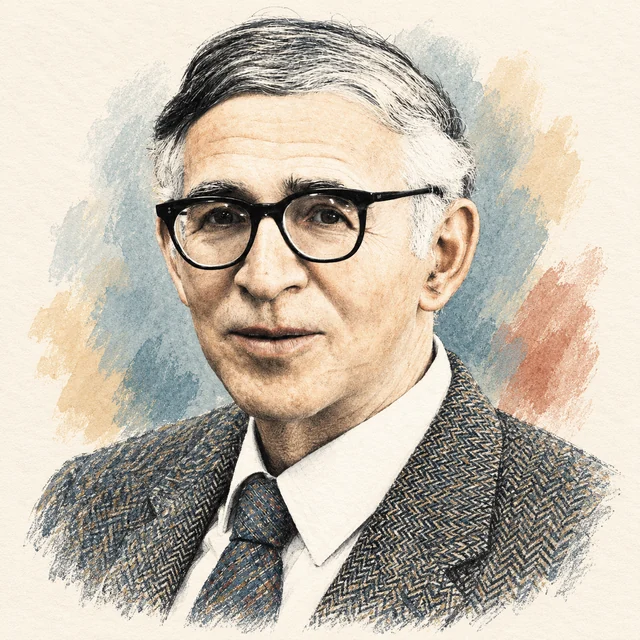
A life in context
The person behind the prize
Born in Lithuania, Klug moved with his family to Durban as a small child. At Witwatersrand he began with medical studies, then turned to chemistry, physics and mathematics. In Cape Town, R. W. James introduced him to crystallography and Fourier methods. He moved to Cambridge in 1949 for doctoral research under D. R. Hartree on phase changes in solids. At Birkbeck in the 1950s he collaborated with Rosalind Franklin on tobacco mosaic virus, alongside John Finch, Kenneth Holmes and others. After Franklin’s death he continued the virus programme; the group moved to the MRC Laboratory of Molecular Biology in 1962. He later directed the laboratory from 1986 to 1996. His interests ranged across viruses, RNA and chromatin rather than one imaging instrument.
The contribution
Klug developed crystallographic electron microscopy: quantitative analysis of electron images to recover three-dimensional structural information. His studies clarified how nucleic acids and proteins form organised complexes. He received the full Chemistry Prize. The work joined imaging, diffraction, mathematics and collaboration; it was distinct from the later cryo-electron microscopy award of 2017.
The idea in plain language
A protein–nucleic-acid complex has organisation that a single flat view can hide. Electron microscopy gives images, while diffraction and Fourier methods describe how structural information is distributed. Klug brought crystallographic thinking to electron-image analysis, using multiple views and suitable specimen organisation to infer three-dimensional maps.
Read the full award story ↗

